Taxi Driver Review (1976): The Loneliness Behind Travis Bickle’s Final Act
Taxi Driver is not a film about a man who finally discovers his purpose. It is a film about a man who mistakes his isolation for moral authority and finds a society willing to misunderstand what he has done. That distinction is why Martin Scorsese and screenwriter Paul Schrader’s film remains disturbing.
Full spoilers. Robert De Niro stars as Travis Bickle, with Jodie Foster, Cybill Shepherd, Harvey Keitel and Albert Brooks. AFI’s Scorsese filmography.
Explore the Martin Scorsese director page for more films and reviews.
New York through a distorted perspective
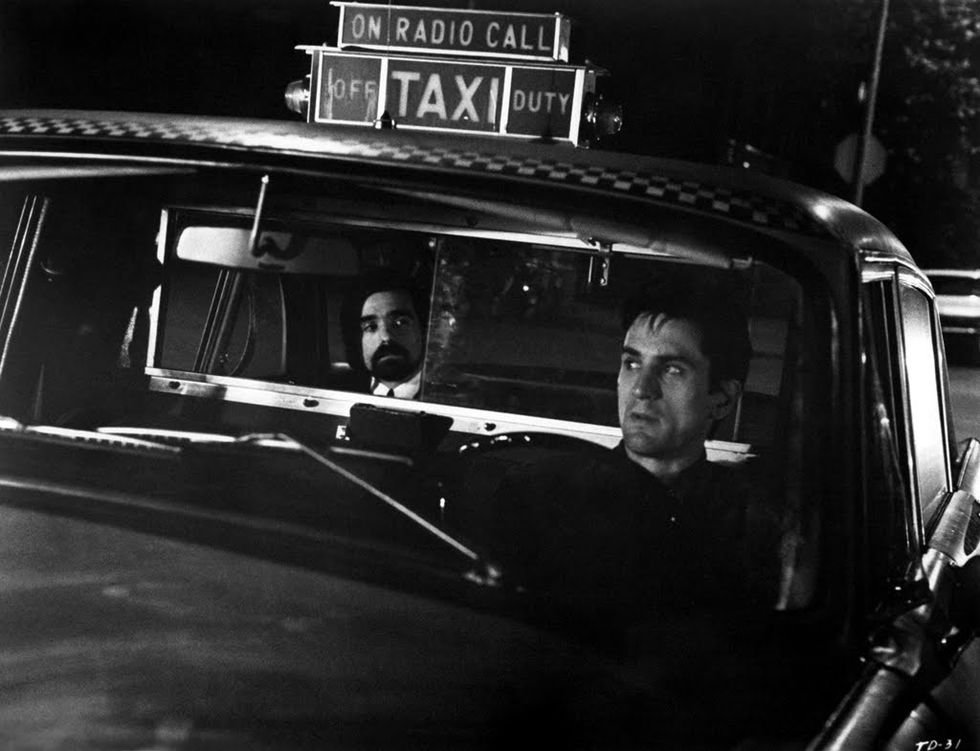
Travis, a Vietnam veteran working nights in a taxi, sees strangers through glass, mirrors and passing lights. The city is full of people, yet he experiences it as an environment from which he is excluded. The narration turns his opinions into a private monologue; the images do not necessarily certify those opinions as true.
Michael Chapman’s photography and Bernard Herrmann’s final film score make the city simultaneously alluring and threatening. The recurring saxophone suggests a romantic version of nighttime New York that the harsher musical passages undermine. The effect is a conflict between desire and dread rather than a single uncomplicated mood.
Betsy and the inability to see another person
Travis idealizes Betsy before he knows her. Their awkward date exposes the gap between his fantasy and his social understanding. When she rejects him, he interprets the experience through an increasingly hostile worldview rather than reconsidering his own behavior. De Niro is especially effective in the moments when Travis attempts ordinary conversation and cannot read the response.
Iris and the danger of a self-appointed savior
Iris is a vulnerable adolescent, and Travis develops a fixation on rescuing her. His concern exists alongside resentment, grandiosity and his earlier fixation on a political candidate. The film resists treating those motivations as a stable heroic identity. Jodie Foster gives Iris an independent presence, complicating the story Travis wants to tell about her.
The violence near the conclusion is deliberately ugly, not a satisfying release from earlier frustration. Its aftermath is even more disturbing because public reporting turns Travis into a hero. The narrative that society adopts leaves out the instability the audience has witnessed.
Is the ending a dream?
Some viewers interpret the final scenes as fantasy, and the mirror glance in the closing moments encourages unease. The film does not explicitly identify the epilogue as a hallucination. Reading the events literally produces an equally powerful conclusion: society can reward a dangerous person when his actions happen to fit a convenient narrative. Travis has not necessarily changed.
Why it endures
Taxi Driver offers proximity to a damaged perspective without turning proximity into endorsement. The film understands that isolation can coexist with hostility, and that people are not entitled to authority merely because they feel alienated. Its achievement is making the viewer experience that confusion while remaining able to recognize it.
Verdict: 10/10. A formally precise, unsettling portrait of self-deception. Trailers and clips.