Jackie Brown (1997) Review: Quentin Tarantino’s Most Human Crime Film
Jackie Brown is the Tarantino film to recommend to someone who has grown tired of Tarantino imitations. It has crime, humor and elaborate deception, but its most compelling question is whether two people who have spent their lives making practical compromises can afford to choose each other.
Full spoilers. Directed by Quentin Tarantino, adapted from Elmore Leonard’s Rum Punch, starring Pam Grier, Robert Forster, Samuel L. Jackson and Bridget Fonda. Miramax director profile.
Explore the Quentin Tarantino director page for more films and reviews.
The story: an opportunity to escape a narrow life
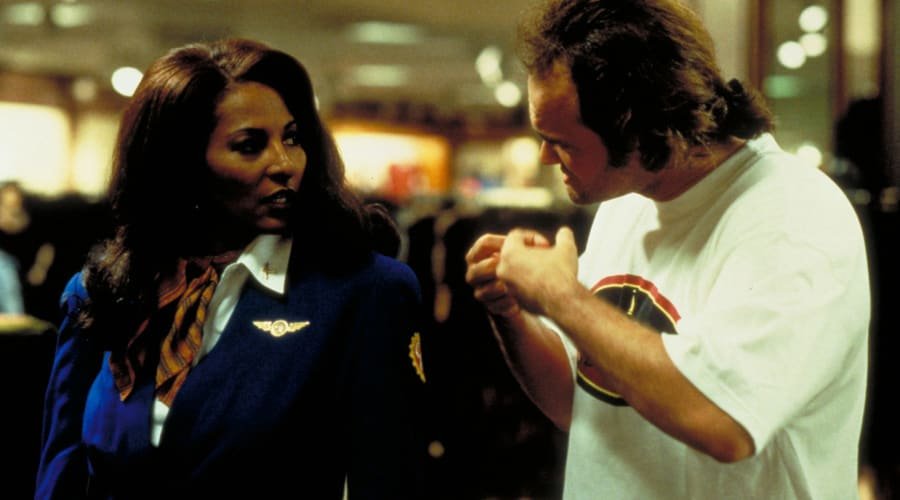
Jackie is a flight attendant who becomes caught between law enforcement and arms dealer Ordell Robbie. She recognizes that the people pressuring her have underestimated her options, and she develops a scheme to escape with money of her own. The premise is less about the technical details of the deception than about the value of time. Jackie cannot easily start over if she loses her job or her freedom.
Pam Grier’s performance makes that urgency visible without relying on speeches. She can be polite, frightened, calculating and resolute within one conversation. Robert Forster’s Max Cherry is a bail bondsman whose attraction to her develops through attention rather than conquest. Their exchanges feel unusually adult in a crime film built around characters trying to outmaneuver one another.
The mall sequence: perspective rather than surprise
Tarantino revisits the money exchange from different points of view. The effect is not simply to conceal an answer until the last possible moment. Each perspective reveals how a character has misread the people around them. Jackie’s advantage is that she understands those misconceptions better than they understand her.
Ordell’s confidence and Louis’s frustration
Samuel L. Jackson’s Ordell treats his conversational confidence as evidence that he controls every interaction. Robert De Niro’s Louis, by contrast, is frequently bewildered by the complexity of the situation. His impulsive violence exposes the fragility of Ordell’s arrangements. The film makes foolishness dangerous without presenting it as glamorous.
Why Max does not go with Jackie
Jackie ultimately gains the possibility of leaving, but Max chooses to stay behind. Their farewell is poignant because the film has allowed the possibility of a life together to feel real. It avoids promising that a successful escape resolves every personal hesitation. Max may understand what he wants without being prepared to abandon the life he knows.
The ending’s use of Across 110th Street connects Jackie to the film’s opening and changes the emotional meaning of the journey. Her expression contains relief and sadness without telling us which feeling will dominate her future.
The verdict
9/10. Jackie Brown is proof that Tarantino’s strongest gift may be his ability to write people listening to each other. Its slower pace is an advantage: the outcome matters because the film makes us care about the lives that will continue after it.