Raging Bull Review (1980): Robert De Niro and the Violence Jake LaMotta Cannot Escape
Raging Bull is a sports film that refuses the most familiar promise of sports films: that discipline and physical courage will lead to personal growth. Jake LaMotta can survive punishment in the ring, but the qualities that make him a formidable boxer do not make him capable of sustaining trust.
Full spoilers. Directed by Martin Scorsese, starring Robert De Niro, Cathy Moriarty and Joe Pesci. MGM’s official trailer.
Explore the Martin Scorsese director page for more films and reviews.
The story: winning fights and losing relationships
Based on LaMotta’s life, the film follows the boxer’s career and the deterioration of his marriage to Vickie and his relationship with his brother Joey. The boxing scenes are selective; Scorsese is less interested in providing a complete record of his sporting achievements than in studying how Jake reacts to humiliation and uncertainty.
Cathy Moriarty’s Vickie is crucial. Her ordinary interactions become evidence in a case Jake has invented in his own mind. The film gives the audience no reason to accept the certainty with which he makes accusations. Joe Pesci’s Joey initially seems capable of navigating Jake’s temperament, until he too becomes a target of suspicion.
Why the ring never looks quite the same
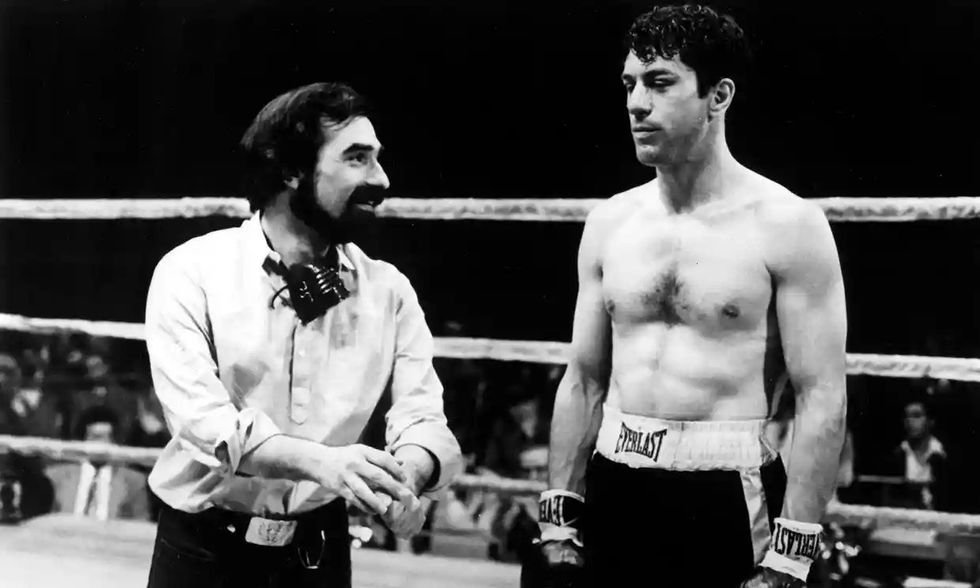
Michael Chapman’s black-and-white photography, the changing sense of space and the expressionistic sound of the fights place us inside different emotional states. The ring is sometimes vast and sometimes oppressive. Scorsese’s filmmaking makes the experience of a fight more important than a stable documentary view of its geometry.
Outside the ring, the scenes are often painfully ordinary. An argument at home does not acquire meaning because Jake was a great athlete. The contrast prevents the boxing from excusing his abuse. De Niro’s performance captures the frightening way a need for reassurance becomes a demand for control.
The jail scene and the final mirror
After his career deteriorates and he is jailed, Jake attacks the wall of his cell and asks himself why his life has reached this point. The scene is powerful because it offers pain without guaranteeing insight. Feeling terrible about the consequences of one’s behavior is not the same as accepting responsibility for that behavior.
In the final sequence, an older Jake rehearses dialogue from On the Waterfront before a mirror. The language of missed opportunity belongs to another film, and his performance of it is ambiguous. He can borrow another man’s explanation of failure; the question is whether he has developed one of his own.
Why the performance matters more than the transformation
De Niro’s physical changes are famous, but the subtler achievement is the continuity of Jake’s behavior across the years. The body alters; the need to dominate an interaction remains. Thelma Schoonmaker’s editing and Scorsese’s refusal of a tidy redemption make that continuity impossible to overlook.
Verdict: 10/10. A devastating film about a man who treats vulnerability as defeat. Its refusal to make suffering equivalent to redemption is what makes it great.