Cure 1997: What If Evil Didn’t Need a Reason?
Smart summary
Cure 1997 is Kiyoshi Kurosawa’s psychological horror film about a detective chasing a string of killings committed by ordinary people who cannot explain why. Its terror comes from suggestion and empty rooms, not monsters, which makes it one of Japan’s most unsettling horror films.
THE UNHOLY ARCHIVE / 05 · DEEP CUTS · EDITORIAL
A detective story promises an explanation. A crime happens, evidence is collected and a suspect emerges. Even when the investigation is frightening, the audience can usually trust the idea that events have a cause. Kiyoshi Kurosawa’s Cure begins by offering that familiar structure and then methodically undermines it.
Researching this 1997 Japanese film reveals a work whose reputation rests less on explicit horror than on the uncertainty that survives each apparent discovery. A detective can find an answer to one question only to realise the answer has made the world less intelligible.
A procedural with a hole in its centre
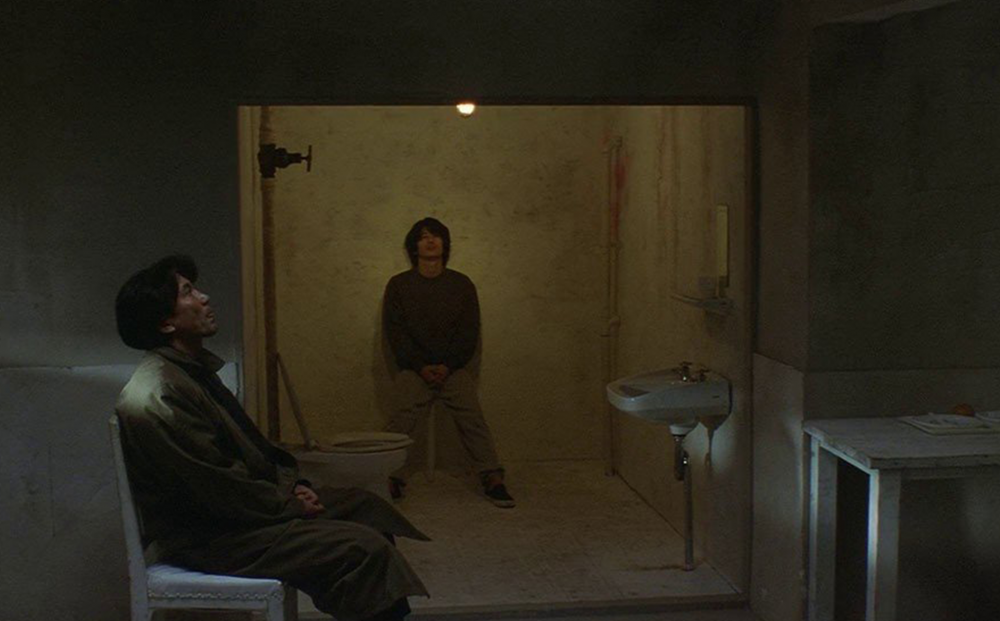
Kōji Yakusho plays Detective Takabe, investigating apparently connected killings committed by people who are not linked through a conventional criminal organisation. A mysterious man named Mamiya, played by Masato Hagiwara, becomes important to the inquiry. The Criterion Collection situates the film at the emergence of a new period in Japanese horror and emphasises its philosophical reach.
The premise is frightening because it disrupts the comfortable separation between the detective, the criminal and ordinary citizens. A typical investigation identifies someone who is different from the people around them. Here, the relationships between apparently ordinary individuals and their acts are precisely what need explaining.
Rooms that do not explain themselves
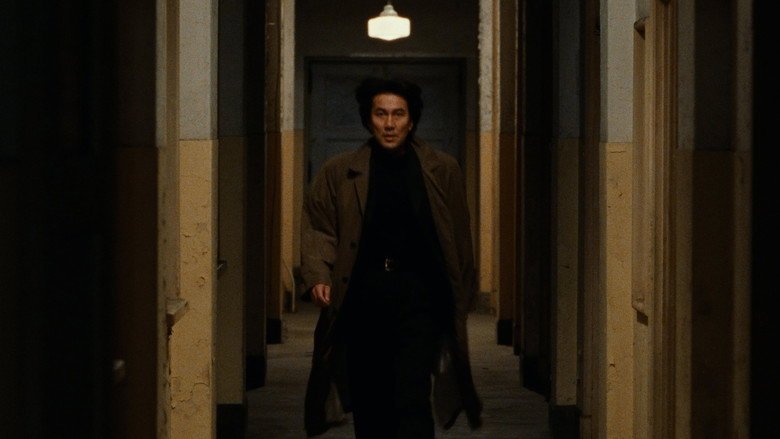
Much of the film’s visual reputation concerns sparse interiors, restrained framing and the distance between people. Consider the still of two men seated in a bare room under a single light. One figure occupies the foreground, the other appears across the space. There is no obvious visual eruption that tells us exactly where danger resides.
In a conventional suspense scene, a close-up directs us toward an important expression or object. Kurosawa’s more distant arrangements allow the viewer to consider competing points of attention. The room becomes a field of possibilities. A pause in conversation can be as consequential as a visible movement.
It is a strategy that also makes the camera seem indifferent. We are accustomed to films placing us in the privileged position of a spectator who can see what matters. When a director withholds that privilege, the fear is partly a fear of failing to notice the decisive thing.
The unsettling question of identity
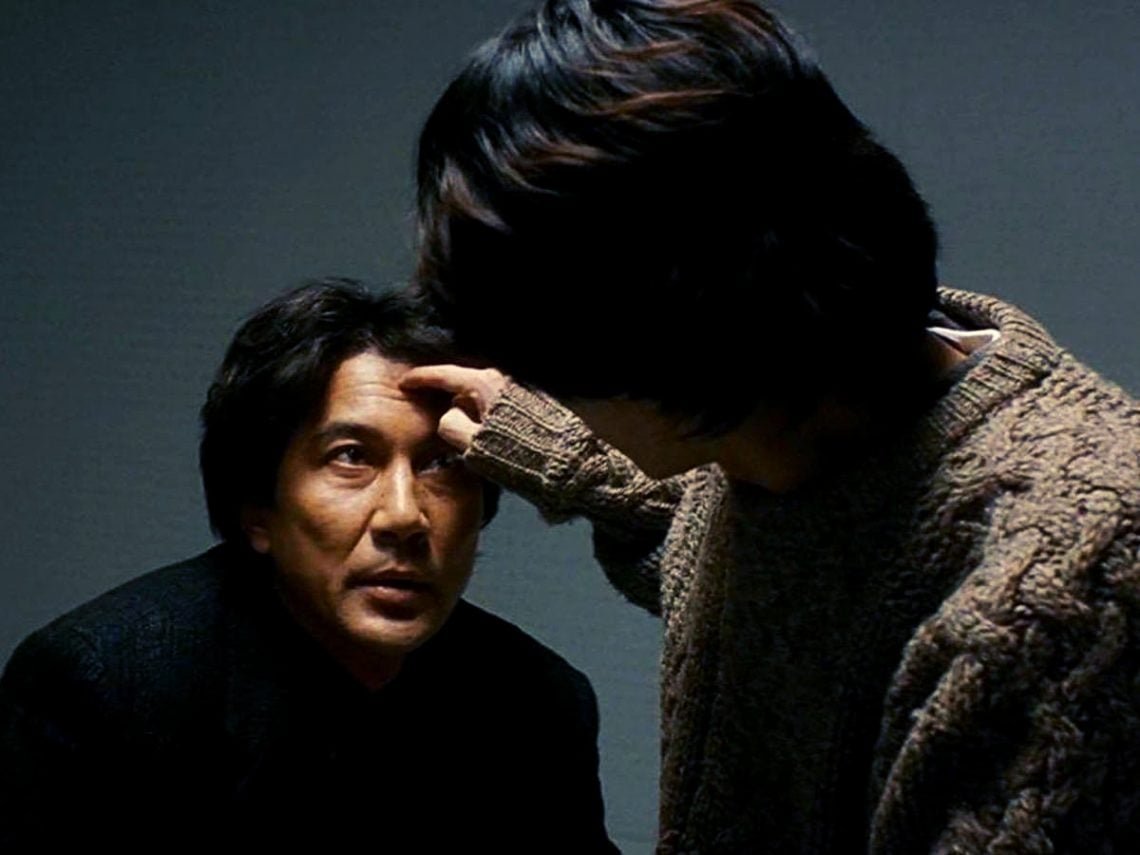
Mamiya’s apparent disconnection from his own history turns conversations into encounters with someone who does not participate in the normal exchange of biographical information. Rather than treating the character as a realistic demonstration of hypnosis, the film uses the device to ask what remains when a person’s familiar sense of self is destabilised.
Actual hypnosis does not establish the supernatural powers attributed to fictional characters. The distinction matters because the film’s power lies in imagining a world where ordinary safeguards of identity seem unreliable, not in explaining how real people can be controlled.
The title itself raises another problem: what exactly is being cured? A cure implies a healthy condition to which a person can return. In a story where the nature of the disturbance is in doubt, that language becomes an unsettling promise. Perhaps the greatest fear is that what seems abnormal cannot be cleanly separated from what came before.
Why Cure belongs beside Japanese media horror
Criterion’s essay on the film connects its eerie treatment of recorded media to later Japanese horror, including Hideo Nakata’s Ring and Kurosawa’s own Pulse. The relevant connection is not that all three films tell the same story. Each explores a medium or everyday system that becomes unable to guarantee the boundary between human life and an unfamiliar force.
That anxiety is particularly interesting today. Screens and recorded evidence promise to clarify the world. Horror can reverse that promise: the more a character reviews the evidence, the less stable their interpretation becomes.
Who should watch Cure 1997?
On the basis of the available critical essays and filmmaker material, this belongs high on the list for viewers who like procedural mysteries, slow-burn horror and films that leave room for interpretation. It is not an easy replacement for a conventional slasher or a film designed around surprise reveals. Its pace is central to its argument.
Our critical reading is that Cure asks whether discovering the source of a threat is the same as understanding it. A detective can name a suspect. A filmmaker can show us a room. Neither action necessarily makes the darkness in that room go away.
The PYLCROW Horror Index
Editorial assessment of the film’s reported techniques and subject matter, not a firsthand viewing score.
The Rabbit Hole
- Noroi: The Curse — investigation as a route into increasing uncertainty
- Pontypool — the terror of communication itself
- Beksiński — images that resist a definitive explanation