Ghostwatch 1992: The Night British TV Made Horror Feel Real
Smart summary
Ghostwatch 1992 was a scripted BBC One drama, broadcast on 31 October 1992, that looked like a live investigation of a haunted house fronted by familiar presenters. It worked because it turned the BBC’s own trusted format into the monster, and the reaction still shapes how hoax-style horror is judged.
THE UNHOLY ARCHIVE / 06 · DEEP CUTS · EDITORIAL
In 1992, a television audience could switch on the BBC and expect a familiar arrangement: a presenter in a studio, a correspondent at a location and a direct connection between the two. That arrangement was part of the promise of live television. On Halloween, Ghostwatch used the promise itself as the foundation of a horror story.
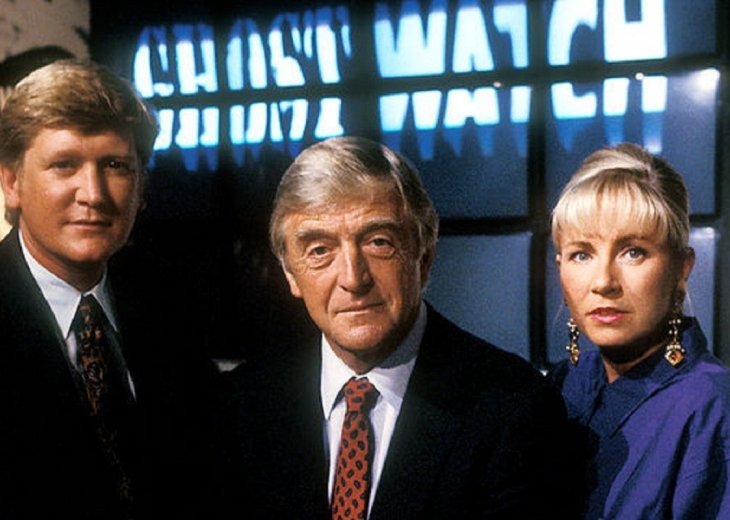
The programme was scripted fiction, written by Stephen Volk and directed by Lesley Manning. It was broadcast on BBC One on 31 October 1992. But instead of looking like a conventional ghost film, it resembled a live investigation into an allegedly haunted house. Real television personalities appeared as themselves. The unsettling result helped demonstrate what happens when an audience cannot immediately tell the difference between a fictional event and the familiar language of factual broadcasting.
How the BBC’s own format became the monster
Michael Parkinson provided the studio presence, while Sarah Greene, Mike Smith and Craig Charles participated in the fictional broadcast. The household at its centre was occupied by the Early family, whose reports of disturbances are attributed within the drama to a presence nicknamed Pipes.
The British Film Institute notes that the programme was made in advance for the Screen One drama strand. Its apparent immediacy was therefore a performance. That is important: the event shown on television was not a verified investigation of a real haunting. The historical event was the transmission of an unusually persuasive fictional programme.
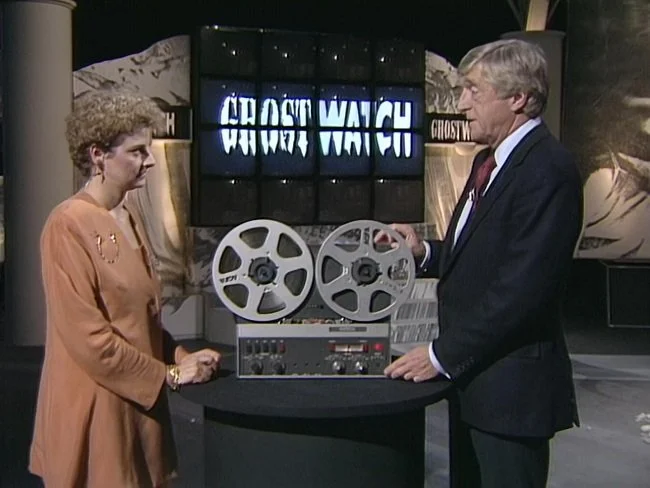
Studio microphones, video screens, phone conversations and familiar presenters act like signs of institutional authority. A ghost film must establish the credibility of its fictional world from scratch. Ghostwatch borrows the credibility already attached to television, then makes that credibility increasingly difficult to trust.
Why a hidden figure is more effective than a spectacular apparition
The programme has developed a reputation for fleeting glimpses of Pipes. The figure is not always presented as the obvious centre of an image. Viewers can find themselves scanning the background, inspecting curtains or replaying a sequence because the programme has made the act of watching feel like part of the investigation.
A visual effect that is too clear can give an audience relief: now we know the appearance of the monster and how the film intends to frighten us. An ambiguous shape does the opposite. It creates uncertainty about perception itself. Did the image actually contain something, or did the expectation of a ghost cause us to interpret a shape that way?
Our comparison with the Stoneham painting is especially useful here. The eBay story taught viewers to look for changes in a still image. Ghostwatch teaches them to look for a presence in the moving background of a broadcast. In both cases the viewer becomes an investigator, even when the evidence is part of a deliberately constructed artwork.
The reaction and the limits of the experiment
The BFI documents the controversy that followed the original broadcast and the cult following that developed before its eventual home-video release. Accounts differ in how they characterise the scale and nature of the public response, so the important point is not a sensational number. Some viewers experienced the fictional event as something much closer to real television than they anticipated.
The artistic achievement raises a legitimate ethical question. A drama can use ambiguity to create an extraordinary experience. But a broadcaster also carries responsibilities toward an audience that may not share the same knowledge of context. The fact that a programme is labelled as fiction does not mean every viewer will encounter it from the beginning or interpret its format correctly.
Why does Ghostwatch 1992 still matter?
Today, people encounter documentary-style horror through video platforms, podcasts, livestreams and fictional archival material. The central device of Ghostwatch remains recognisable: trust the form long enough for the form to betray your expectations. Its historical setting makes the mechanism particularly easy to study.
The film is a strong recommendation, based on its documented production, critical discussion and influence, for anyone interested in found-footage techniques or the history of horror television. It is best approached as fiction rather than a real paranormal record. Knowing that distinction does not necessarily remove the unease.
Perhaps the reason Ghostwatch remains memorable is that it understood something about television before we became accustomed to inspecting every screen. A frightening story does not need to persuade us that its monster exists. Sometimes it only needs to persuade us, briefly, that the person telling the story is someone we ordinarily trust.
The Rabbit Hole
- The Hands Resist Him — how stories change our interpretation of images
- Lake Mungo — fiction adopting documentary conventions
- Noroi — the horror of an apparently authentic investigation