Beksiński Paintings: A World That Shouldn’t Exist
Smart summary
Beksiński paintings are the dreamlike, decaying landscapes that Polish artist Zdzisław Beksiński, born in Sanok in 1929, made in his fantastic period. He refused to explain them, so their cathedrals, crowds and skeletal figures stay open to each viewer’s own fears.
THE UNHOLY ARCHIVE / 01 · DEEP CUTS · EDITORIAL
There is a particular kind of nightmare in which nothing chases you. You simply find yourself somewhere you cannot explain, surrounded by architecture that seems to have been waiting for your arrival. The light is wrong. The horizon offers no escape. Something that resembles a person stands in the distance, but the closer you look, the less certain you are that it ever was one.
That is the feeling we encountered while researching Zdzisław Beksiński. His paintings make horror feel less like an event and more like a geographical location. They also complicate the convenient label of an artist who painted hell. There is something far more interesting in the work than a collection of images designed to frighten us.
A Polish artist before the nightmare
Born in Sanok, Poland, in 1929, Beksiński trained in architecture and experimented with photography, sculpture, reliefs and drawing before developing the painting style for which he is now widely recognised. The Historical Museum in Sanok, which inherited his artistic legacy, traces an evolution from early abstraction through distorted human figures to the visionary landscapes of his fantastic period.
That background matters. His worlds do not simply look like monsters placed on a canvas. Their structures often appear designed. Columns, corridors and towers seem to obey an internal order, even when their scale or material feels impossible. Architecture provides the skeleton of the nightmare.
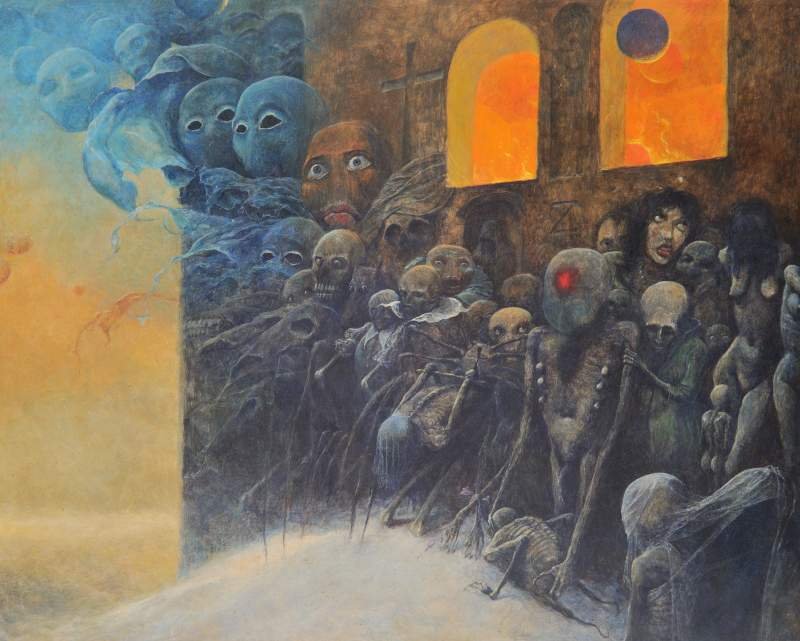
AA70: a crowd that offers no comfort
In the 1970 painting AA70, faces and skull-like heads gather below glowing openings. The orange illumination should provide a point of warmth. Instead, it makes the blue-grey figures more difficult to place. Are they survivors, congregants or something entirely different? The scene refuses to make the answer obvious.
Crowds in conventional paintings tend to communicate a shared action: worship, celebration, protest, flight. Here the grouping feels more like an accumulation of beings whose relationship to one another has been lost. The viewer is not given a protagonist to follow. There is no safe character through whom we can experience the world.
The cathedral that looks almost alive
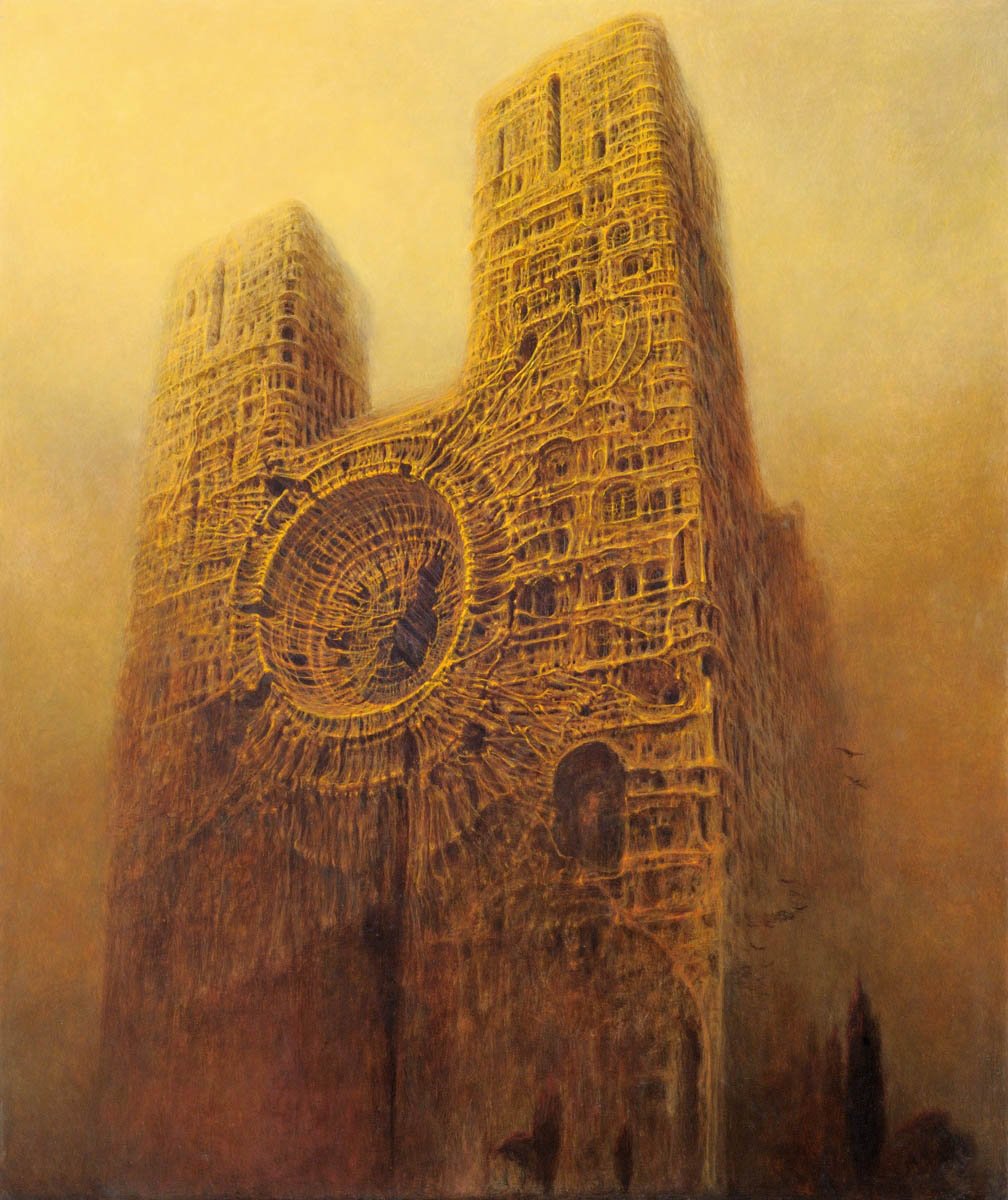
AA83 provides a different kind of dread. The two towers and circular central structure evoke a cathedral, but the surface seems less like stone than a network of ribs, fibres and damaged tissue. Architecture becomes biological without entirely abandoning its architectural identity.
The horror here comes from a contradiction. A cathedral is ordinarily associated with shelter, ceremony or transcendence. Beksiński gives us a recognisable silhouette while making the material alien. It looks like a building that has been growing for centuries, indifferent to whether humans are still present to use it.
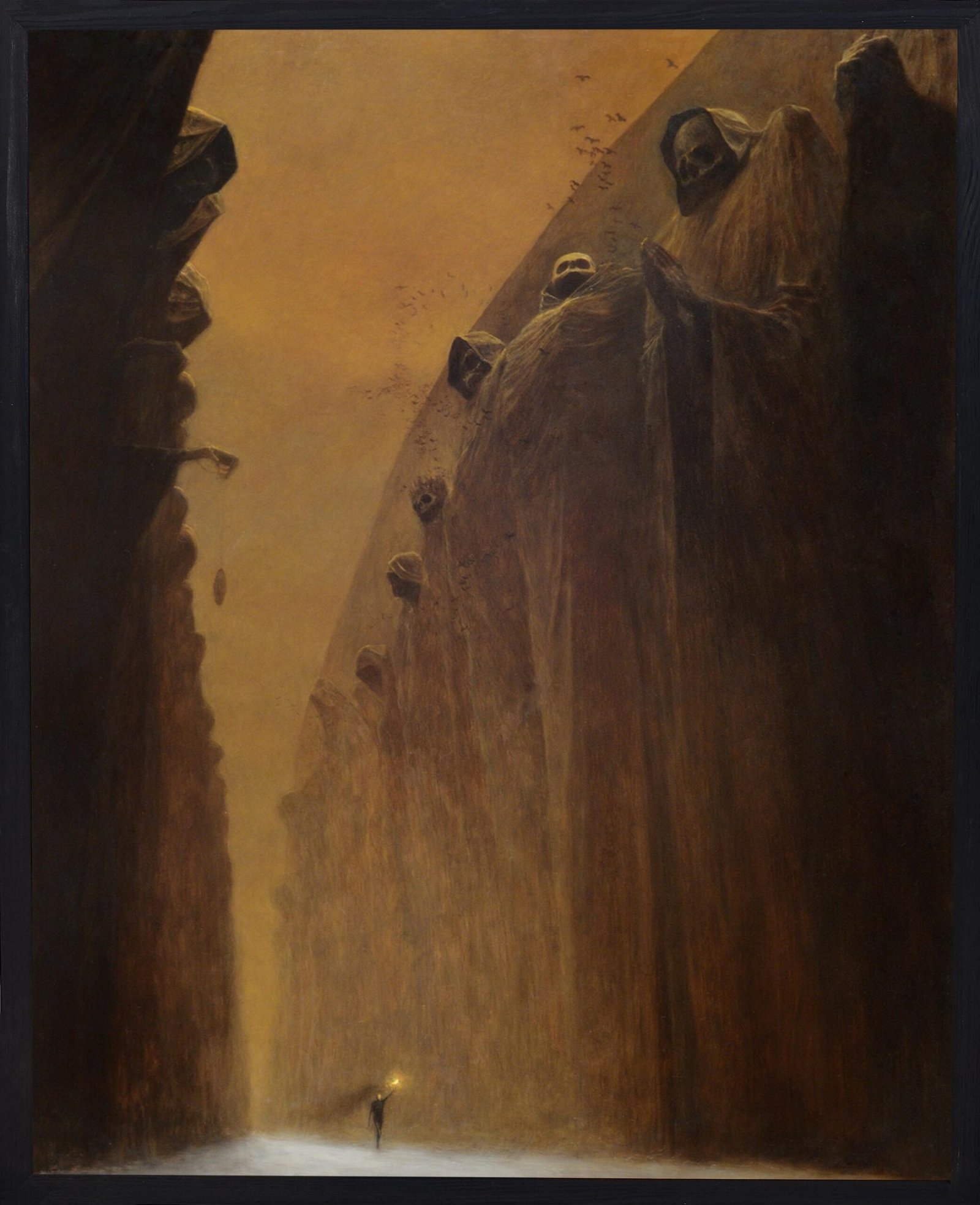
AA72 likewise uses enormous scale to make the viewer feel insignificant. Repeated shadowy forms seem to inhabit the walls of a passage. The composition suggests movement through a place, but it supplies no destination that promises safety. It is the visual equivalent of a corridor whose end you are afraid to discover.
Are Beksiński paintings really visions of hell?
That interpretation belongs to viewers. The museum describes the fantastic period in terms of imagination, dreams and a tension between beauty and ugliness. It does not establish that the pictures document supernatural experiences. Their often untitled presentation discourages one definitive narrative.
There is a temptation to explain everything through the tragedies of the artist’s family and his violent death in 2005. Those facts belong to his biography, but treating every painting as a prediction of his fate turns the work into a sensational story and obscures decades of experimentation. We cannot infer a man’s beliefs or mental state from a frightening image.
Why the beauty is the frightening part
If these landscapes were merely unpleasant, looking away would be easy. Their appeal is the precision with which incompatible elements coexist: a warm sky over a ruined landscape, a delicate contour around an impossible body, a monumental building that seems to have forgotten its purpose. The eye wants to keep investigating even when the imagination wants to withdraw.
That is also why the paintings fit naturally beside slow horror cinema. A filmmaker can move a camera through an empty room and make us inspect the farthest corner. Beksiński gives us that same invitation in a single frame. The viewer supplies the movement, the imagined sound and the question of what might happen next.
Our reading is that Beksiński’s most unsettling achievement is not depicting evil itself. It is creating a world that has no obligation to explain itself to us. A nightmare normally ends when we wake. These paintings remain available for another visit.
The Rabbit Hole
- Franz von Stuck’s Lucifer — another way an image makes the viewer feel watched
- Skinamarink — how empty spaces become threatening