The Hands Resist Him: The Painting Nobody Wanted in Their Home
Smart summary
The Hands Resist Him is a 1972 painting by Bill Stoneham of a boy and a doll-like girl in front of a glass door, based on a childhood photograph. It became an internet legend in 2000 when an eBay listing claimed it was haunted, but nothing supports the curse.
THE UNHOLY ARCHIVE / 02 · DEEP CUTS · EDITORIAL
Imagine opening an online auction and finding a painting whose seller appears more interested in warning you than selling it. The picture depicts a boy standing beside a doll in front of a glass door. Behind the glass, hands reach toward the outside. The description claims something about the image is wrong. You do not have to believe in ghosts to understand why the story spread.
Bill Stoneham painted The Hands Resist Him in 1972. Decades later it acquired a second identity, not through a gallery’s interpretation, but through a listing on eBay in 2000. What makes this story worth investigating is the distance between the artist’s picture and the frightening object the internet invented around it.
Look at the painting before reading the legend
The artist’s official gallery displays the original painting and its sequels. We recommend opening it separately before continuing. The original image requires permission for digital republication, so we link to the rights-holder’s presentation rather than reproduce it here.
Notice the way the boy occupies the centre of the composition. He appears solid, almost confrontational, but his companion is artificial. The glass divides the ordinary foreground from a black space that holds the hands. The distinction between inside and outside is clear in the architecture and unclear in the story. The viewer cannot determine what those hands belong to, whether the figures can see them, or what the door is keeping apart.
Nothing needs to move. The composition makes movement seem possible. That is a different effect from a painting that explicitly depicts violence: the disturbing event exists in the viewer’s anticipation.
A childhood photograph, not an exorcism
Stoneham explains that the painting originated in an old photograph of himself with a friend outside a Chicago apartment when he was five. He describes the door as a boundary between dreaming and waking, the doll as an imagined companion and the hands as other lives. The title also has a personal connection to a poem about his unknown origins and adoption.
That explanation transforms the work. Instead of reading it as two children threatened by disembodied figures, we can see it as an investigation of identity and possibility. What might exist on the other side of the life we know? What kind of person would we have become under different circumstances?
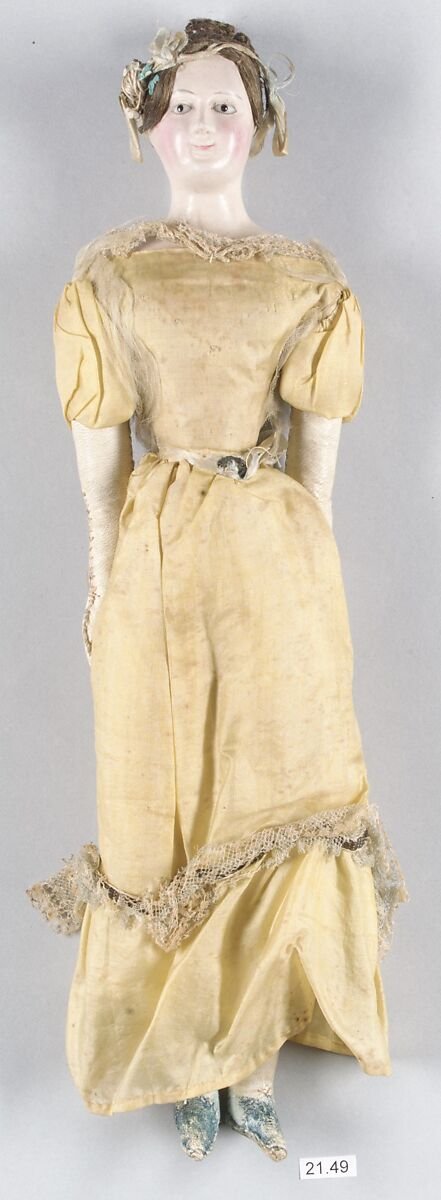
Dolls are useful to horror because they reproduce selected features of human presence without behaving like a human being. A fixed stare can appear attentive or vacant depending on how long we look. A child-shaped object becomes especially strange when the narrative asks us to decide whether it is a companion, an observer or a threat. Stoneham’s doll is more complicated than a conventional evil toy; its creator understood it as a guide.
How eBay turned the painting into folklore
In 2000 an auction listing introduced the painting to online audiences as an allegedly haunted object. Its eventual buyer, Kim Smith of Perception Gallery, contacted the artist, bringing Stoneham back into the history of a picture he had not discussed for years. The studio’s account acknowledges gaps in its ownership history and explicitly warns readers against uncritical belief in internet retellings.
The claims that the figures moved or that the picture caused unusual experiences are anecdotes, not independently established supernatural events. A sequence of photographs cannot by itself prove that a subject within a painting changed; lighting, reflections, framing and interpretation can change what an observer perceives.
Yet the auction format gave the legend an unusual force. A scary story normally has a narrator and a reader. An auction adds a possible transaction. Suddenly the reader is invited to imagine what would happen if the object entered their own home. The horror is no longer confined to someone else’s narrative.
The artist did not stop at the original
Stoneham returned to the imagery in Resistance at the Threshold (2004), The Threshold of Revelation (2012), The Hands Invent Him (2017) and What Remains (2021). The official gallery describes the figures changing with time and the work becoming connected to discoveries and losses in the artist’s own life. This evolving sequence deserves attention independent of the auction.
The prequel-like 2017 work offers a particularly interesting reversal: we see the familiar situation from the other side of the glass. A device that once prevented access becomes the means of reconsidering the entire image. It is an artistic response to uncertainty, rather than evidence for a curse.
Is The Hands Resist Him really haunted?
Our argument is that the internet did not simply report a haunted painting. It taught audiences how to look at it. The narrative arrived first for many viewers, directing attention to the eyes, hands and dark glass. Every ambiguous detail then became a candidate for confirmation.
That mechanism is the real reason the story belongs in The Unholy Archive. You can reject the supernatural claims and still feel uneasy in front of the painting. The work does not require a ghost to function. Its most persistent companion is the story that people carry with them when they look.
The Rabbit Hole
- Lucifer — the difference between a disturbing gaze and a supernatural claim
- The Bat-Woman — the power of an image that withholds its explanation