Avatar: Fire and Ash Spoiler Review — Varang and the Trouble With Pandora’s Third Chapter
The most compelling thing about Fire and Ash is not the fire. It is the possibility that Pandora can contain people who reject the values on which the previous two films were built. Varang’s introduction expands the moral geography of this universe. The difficulty is that the third film does not always let that new idea change the shape of the story.
Full spoilers for Avatar: Fire and Ash (2025). Directed by James Cameron; starring Sam Worthington, Zoe Saldaña, Oona Chaplin, Stephen Lang, Sigourney Weaver and Jack Champion. Official film page.
Explore the James Cameron director page for more films and reviews.
Neteyam’s death is not over
The Sullys begin the film living with the aftermath of the previous chapter. The death of their eldest son has changed their relationships, particularly Neytiri’s relationship with the humans who remain in their world. Grief is expressed as anger, guilt and a desire to protect the remaining children. These reactions do not necessarily bring the family closer together.
That is the strongest dramatic starting point Cameron could have chosen. A family can survive a battle without knowing how to survive each other afterward. Jake’s instinct is to find practical answers; Neytiri is living with an injury that cannot be resolved by better tactics. The film’s most intimate scenes are the ones that recognize the difference.
Varang makes the Na’vi more interesting
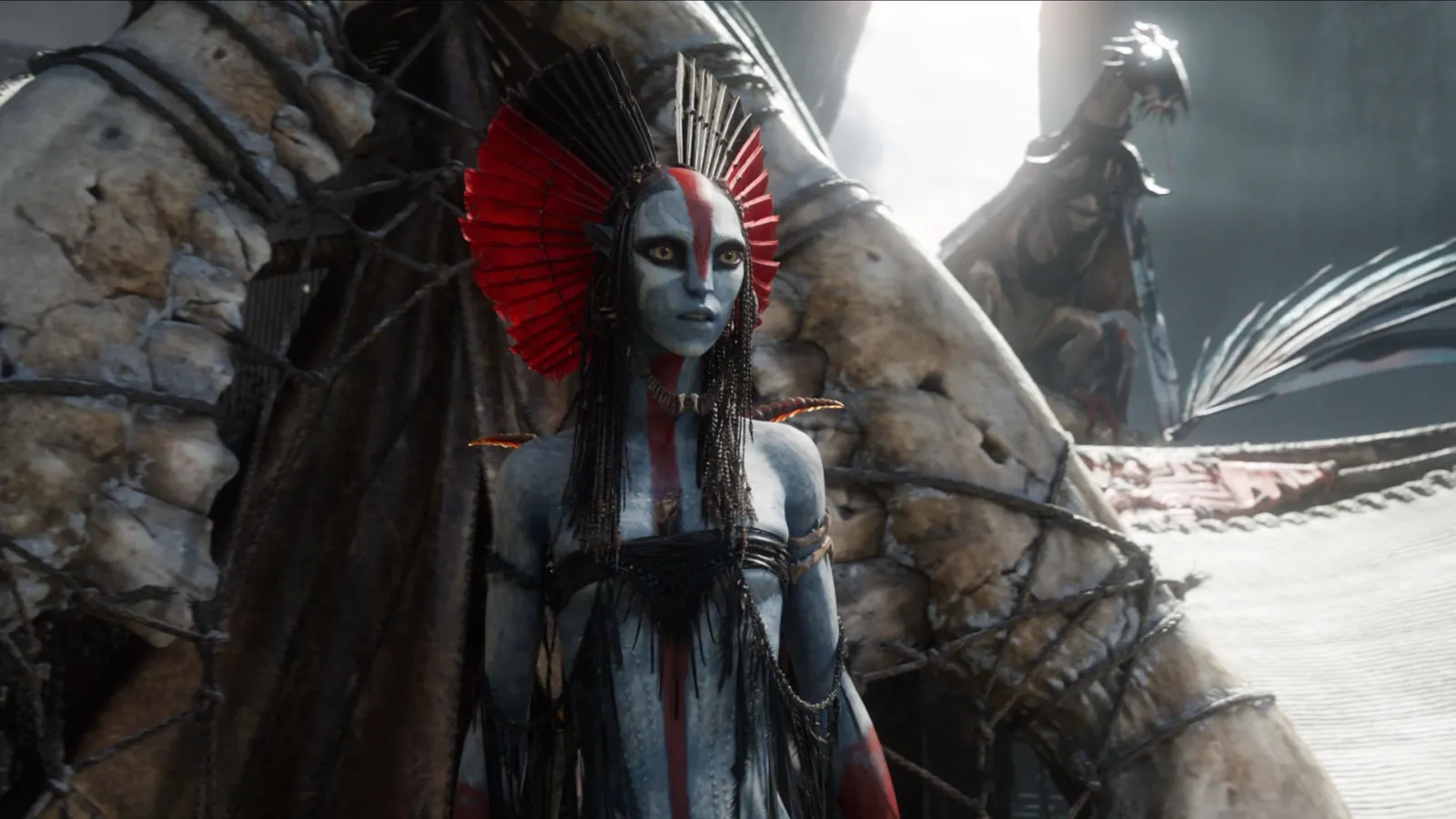
The Mangkwan clan has experienced disaster and does not approach Eywa with the same reverence as the communities we met previously. Varang presents a worldview rooted in abandonment and anger. Her relationship with Quaritch opens the possibility of an alliance that cannot be explained simply as humans against Na’vi.
Oona Chaplin’s performance matters because she gives Varang a confident physical and emotional vocabulary distinct from Neytiri’s. She is not merely a different-colored version of an existing character. The franchise becomes richer when its cultures have conflicting interpretations of their environment and their past.
Spider and Kiri complicate the idea of belonging
Spider’s ability to breathe Pandora’s atmosphere after Kiri intervenes introduces a possibility that reaches beyond his own survival. Human dependence on technology has been a fundamental distinction in the series. A biological change that challenges that dependency also changes the way the other characters perceive him.
The ethical question is whether Spider belongs because of what he is, what he can do or whom he loves. The film is most interesting when it refuses to make all three questions equivalent. Kiri’s connection to Eywa similarly provides more than an unusual power: it makes her a bridge between understandings of life that the adults around her cannot easily reconcile.
The ending and the repetition problem
The climax brings the competing human and Na’vi interests back into large-scale conflict. What matters emotionally is the movement toward accepting Spider as part of the family and the wider spiritual community. That development does not erase the loss of Neteyam, but it points toward a way of living beyond it. Quaritch throws himself from the rock after the confrontation with Jake and Spider; his death is not conclusively established. Varang retreats after Kiri intervenes in her confrontation with Neytiri. The spiritual conclusion brings Spider into a connection with the deceased through Eywa. See GamesRadar’s detailed ending breakdown.
The action delivers the scale expected of an Avatar film, yet the recurring pattern of family separation, rescue and battle competes with the newer material. Varang and the Mangkwan are a chance to make this universe politically and spiritually complex. Too much of the climax returns us to a dramatic language the series has already mastered.
What should Avatar 4 do differently?
Give the younger generation the power to make choices that alter the future of Pandora. Let rival Na’vi communities disagree without requiring an outside force to settle the argument. Explore the implications of Spider’s altered relationship to the atmosphere and Kiri’s unusual connection to Eywa. These are substantial ideas that do not need another escalation of the same battle to become cinematic.
Verdict: 7.5/10. An impressive film with some of the franchise’s richest new ideas, compromised by familiar narrative architecture. Varang is a reason to return to Pandora; the next installment must give her world the dramatic space it deserves.
Read the complete Avatar retrospective and ranking and our Avatar 4 release-date report.