Goya Black Paintings: The Horrors He Left on His Own Walls
Smart summary
The Goya Black Paintings are 14 dark murals Francisco Goya painted straight onto the walls of his house, the Quinta del Sordo, around 1820 to 1823. They were never meant for public display, and works like Witches’ Sabbath, Atropos and The Dog still feel like private nightmares.
THE UNHOLY ARCHIVE / 03 · DEEP CUTS · EDITORIAL
It is one thing to enter a museum and stand before a frightening painting. It is another to imagine living in a house where the walls themselves are covered in nightmares. In the final years of Francisco Goya’s career, that was the setting in which fourteen works now collectively known as the Black Paintings were created.
These were not initially the framed pictures we encounter today. Their original surfaces were walls at the Quinta del Sordo, Goya’s country house near Madrid. The subjects range from grotesque groups of people to mythological figures and a small dog staring into an expanse of brown and ochre. Their horror changes from room to room, and the quietest painting may be the most troubling of all.
The house, the walls and the missing explanations
Goya bought the property in 1819. The paintings are generally dated to around 1820–1823, when he was in his seventies. He had already endured serious illness and deafness, and his career had witnessed war and political upheaval. Those experiences establish a context, but they do not give us a precise explanation of each image.
The works were transferred to canvas in the nineteenth century and eventually entered the Prado Museum. That process preserved them while changing the way they are encountered. Originally a viewer moved between two rooms in which the compositions occupied actual architectural surfaces. Now we experience them as individual objects in a museum.
It is easy to imagine the house as a haunted setting. There is no need to claim that it was haunted. The extraordinary fact is that these images were created as part of a domestic interior.
Witches’ Sabbath: the horror of a crowd
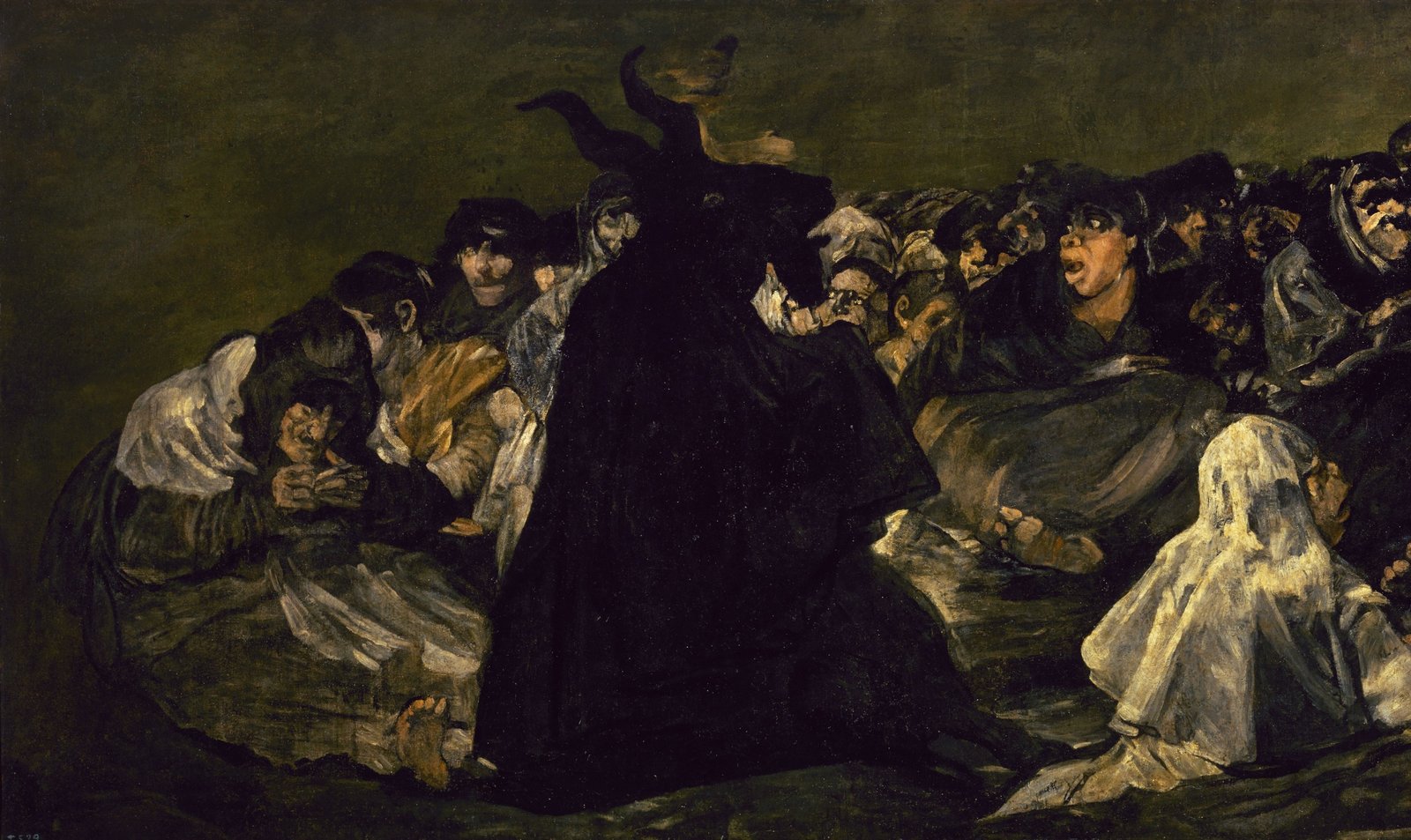
The huge, dark figure of a goat presides over an assembly whose faces are compressed into an uneven mass. The composition is often interpreted through superstition and collective fear. The goat may attract the first glance, but the crowd is the more compelling subject: expressions, open mouths and gestures make it difficult to determine whether the group is threatened, enthralled or complicit.
Goya’s earlier print series Los Caprichos had already explored human folly and superstition. The Black Paintings remove much of the distance that satire can offer. We are not simply watching a foolish gathering from outside; the darkness threatens to absorb the observer’s viewpoint as well.
The Fates: time becomes a monster

In Atropos, a group of suspended figures evokes the mythological beings associated with human destiny. The uncanny aspect is the apparent absence of weight. The landscape lies beneath them while their distorted bodies float in a way that gives the eye no convincing point of support.
Myth can make mortality seem orderly by assigning it figures and roles. Here that order feels compromised. The shapes do not offer a reassuring explanation of fate. They make the viewer feel subject to something whose rules cannot be inspected.
The pilgrimage: ordinary people become unfamiliar
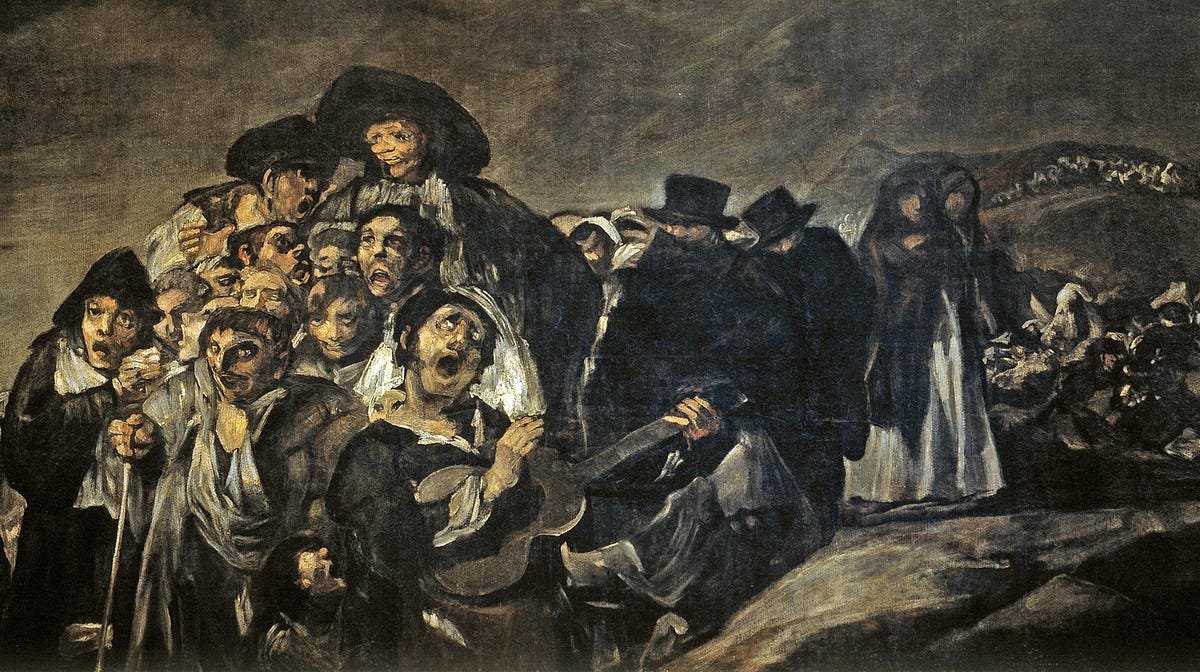
The procession of people in A Pilgrimage to San Isidro is unsettling without requiring a supernatural creature. The distorted faces and closely packed bodies turn a communal occasion into something oppressive. It is a reminder that the human face can carry more terror than a carefully designed demon.
Another famous mural, Saturn Devouring One of His Children, uses the myth of destructive parental power to create a far more explicit image. Its widespread notoriety can make it seem representative of the whole group. But reducing the Black Paintings to Saturn ignores their enormous variety of scale, subject and emotional effect.
The Dog: the one painting that barely contains anything
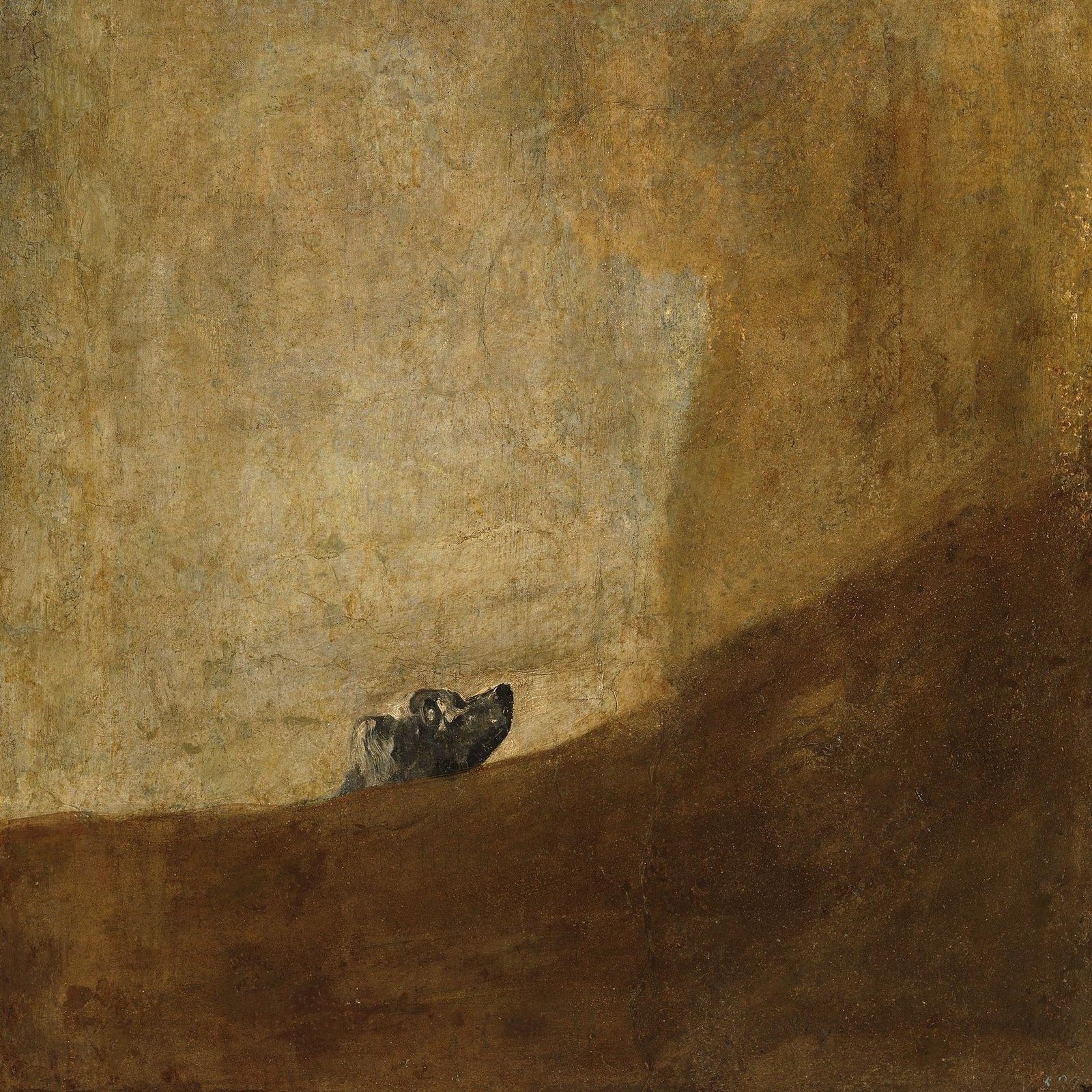
A little head emerges above a sloping brown area. The rest of the image is largely empty. The animal looks upward, but the object of its attention is not clearly present. Is it struggling, waiting, watching or simply existing inside a vast space?
The uncertainty is the painting’s extraordinary achievement. A viewer might bring anxiety, loneliness or even hope to it. The picture does not establish a single narrative. Compared with Saturn, the visible threat is almost absent; compared with a conventional landscape, the emotional pressure is immense.
Our reading is that The Dog anticipates an important device in modern horror: the frightening use of negative space. When an image leaves room for an unseen presence, the imagination can become a more effective artist than any literal depiction of a monster.
Why do the Goya Black Paintings still matter?
We cannot establish what Goya intended every time he lifted his brush. We can examine what the compositions do, how they relate to his career and how later viewers respond. The temptation to diagnose the artist from the murals or label them as evil objects should be resisted.
The Black Paintings are unsettling because they make horror domestic. A house offers protection from the outside world; Goya’s walls remind us that fear, mortality and irrationality can already be inside it. The experience does not end when we leave the museum. Once we know the pictures were walls, it becomes difficult to stop imagining the rooms.
The Rabbit Hole
- Lucifer — nineteenth-century art and the unsettling gaze
- Skinamarink — negative space and domestic dread