
The Departed Review (2006): Martin Scorsese’s War Between Two False Identities
In The Departed, Martin Scorsese gives two men an opportunity to become someone else and then makes that opportunity almost unbearable. The police officer pretending to be a criminal and the criminal pretending to be a police officer are trapped in institutions that measure their value by their ability to lie.
Full spoilers. Directed by Martin Scorsese, screenplay by William Monahan, based on the Hong Kong film Infernal Affairs. Starring Leonardo DiCaprio, Matt Damon, Jack Nicholson, Vera Farmiga and Mark Wahlberg. Berlinale film record.
Explore the Martin Scorsese director page for more films and reviews.
The story: two infiltrators, one collapsing system
Billy Costigan goes undercover in Frank Costello’s organization while Colin Sullivan, recruited by Costello as a child, becomes a police officer. Their lives move in opposite directions, but neither can reveal the truth without risking everything. Scorsese uses the parallel structure to ask who receives the benefits of institutional credibility and who pays for it.
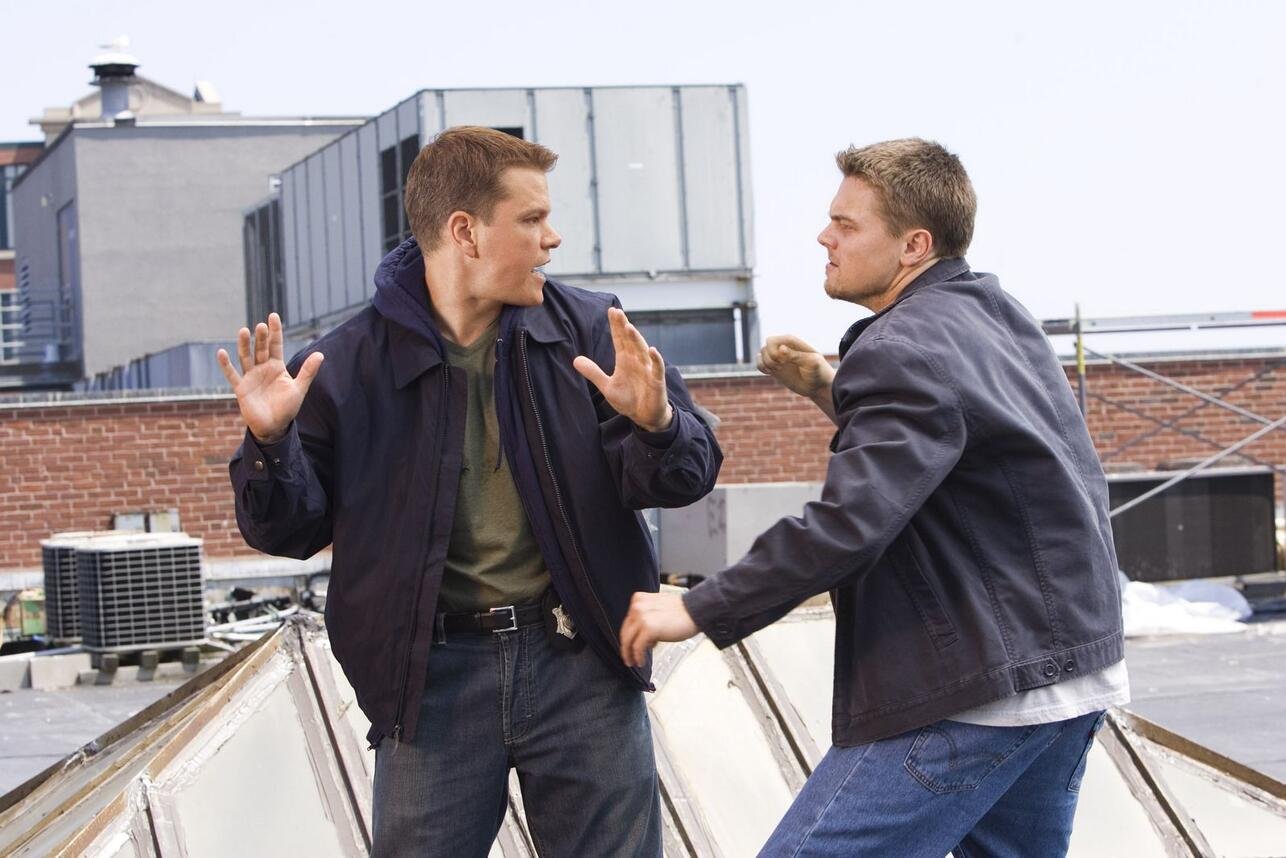
DiCaprio plays Billy as someone whose anxiety is increasingly visible. Damon makes Colin’s deception look like professional ease. That difference is more revealing than a simple good-man/bad-man division: one man is asked to destroy his public identity to serve the police, while the other builds a successful public identity by betraying them.
Costello and the failure of paternal authority
Jack Nicholson’s Costello offers the young Colin an apparent path to independence, but the relationship is structured around dependency. Captain Queenan’s treatment of Billy offers a contrasting kind of authority. Queenan’s death removes one of the few people who can validate Billy’s real identity, leaving the undercover officer vulnerable to the very institution he serves.
Madolyn is more than a narrative intersection
Vera Farmiga’s psychiatrist connects the two protagonists. Her encounters with Billy are among the film’s rare opportunities for a character to express distress rather than conceal it. However, the screenplay also uses her as a device connecting male rivalries; more space for her own perspective would have made the film richer.
The ending: the cost of not being believed
Billy attempts to expose Colin, but is killed as the deception unravels. Colin survives the immediate confrontation only to be killed by Dignam in the final sequence. The rat seen crossing the balcony is a conspicuously literal symbol, an unusual choice in a film that has already conveyed betrayal through every major relationship.
The sudden deaths are not simply a series of twists. They reveal a system in which information can disappear with the only person able to authenticate it. Billy’s moral position cannot guarantee survival or recognition. Colin’s position cannot guarantee immunity. The ending rejects the idea that competence will restore justice in an orderly way.
How it compares with Goodfellas
Goodfellas focuses on the attraction of membership. The Departed focuses on the damage caused by performing membership. Both benefit from Scorsese’s collaboration with editor Thelma Schoonmaker, but the later film uses its parallel plot to create almost continuous uncertainty rather than following one man’s ascent and collapse.
Verdict: 9/10. A superbly acted thriller whose greatest tension comes from the absence of a trustworthy public identity. Its one weakness is occasionally making its symbolism too explicit.


