
Jensen Huang Is Out. How Much of NVIDIA Left With Him?

Jensen Huang on stage at Computex Taipei in 2016. NVIDIA Taiwan, CC BY 2.0 · License. Display may be cropped.
Smart summary
Jensen Huang resigned as NVIDIA’s CEO on November 11 after an affair with a woman US lawmakers suspect of links to Chinese intelligence, and CFO Colette Kress is running the company for now. The stock closed at $166.19 on November 12, and the real test is the November 17 earnings report and whether partners keep signing big commitments without him.
How much of NVIDIA could walk out the door with Jensen Huang? On November 12, investors got their first chance in 33 years to put a price on the question. Shares opened at $151.01, touched $148.80 and closed at $166.19, still down about 4% for the day. Someone who bought at the open and someone who owned the stock overnight could look at the same closing price and have had entirely different Thursdays. Historical prices · Reuters’ market report.
In Taiwan, a supplier had a more practical way of asking the question. An executive whose company worked with NVIDIA told Reuters that it was ready to deliver whatever capacity the chipmaker needed. The uncertainty was whether the next CEO would commit to it as aggressively as Huang. A factory has to be equipped long before anybody knows how many chips it will sell. For the person signing that contract, the difference between the founder and his successor is measured in machinery, payroll and years. Reuters in Taipei and Seoul.
Before the leather jacket, there was a bad bet on Sega
Huang founded NVIDIA in 1993 with Chris Malachowsky and Curtis Priem. The origin story usually fast-forwards from early graphics chips to the AI boom. The part worth stopping for is the project that went wrong. In the 1990s NVIDIA was working on graphics hardware for Sega. Its technical approach had diverged from the direction the industry was taking. Continuing might fulfill an obligation while leaving the company with a product few other customers wanted. Walking away risked losing the customer helping keep it alive.
Huang confronted Sega with the problem. Sega executive Shoichiro Irimajiri ultimately backed an investment in NVIDIA even though Sega would use another company’s technology for the Dreamcast. Retold after decades of success, it sounds inevitable that someone would give this particular engineer another chance. Imagine being the executive in Japan asked to authorize it. The supplier has just explained why its design is wrong. The reason to write a check is that you believe the person who told you. The Wall Street Journal’s account of the Sega decision · Huang’s account in his National Taiwan University address.
The other decisive bet was easier to overlook. NVIDIA introduced CUDA in 2006 so programmers could use its graphics processors for other kinds of computation. In 2012, Alex Krizhevsky, Ilya Sutskever and Geoffrey Hinton described an image-classification system trained on two NVIDIA GTX 580 GPUs. It dramatically improved on the competition in a major image-recognition challenge. Two graphics cards could fit in a research lab. Nobody needed to authorize a billion-dollar facility to find out whether the idea worked. NVIDIA’s product timeline · The researchers’ original paper.
That history explains something the November trading chart cannot. A customer considering another chip today has to price the engineering time it would take to move software, check the results and train people on a different system. Those switching costs survive a chief executive’s departure. The willingness of another executive to commit billions on the strength of a conversation with Huang is a different kind of asset. On Thursday, shareholders owned the first and had to reassess the second.
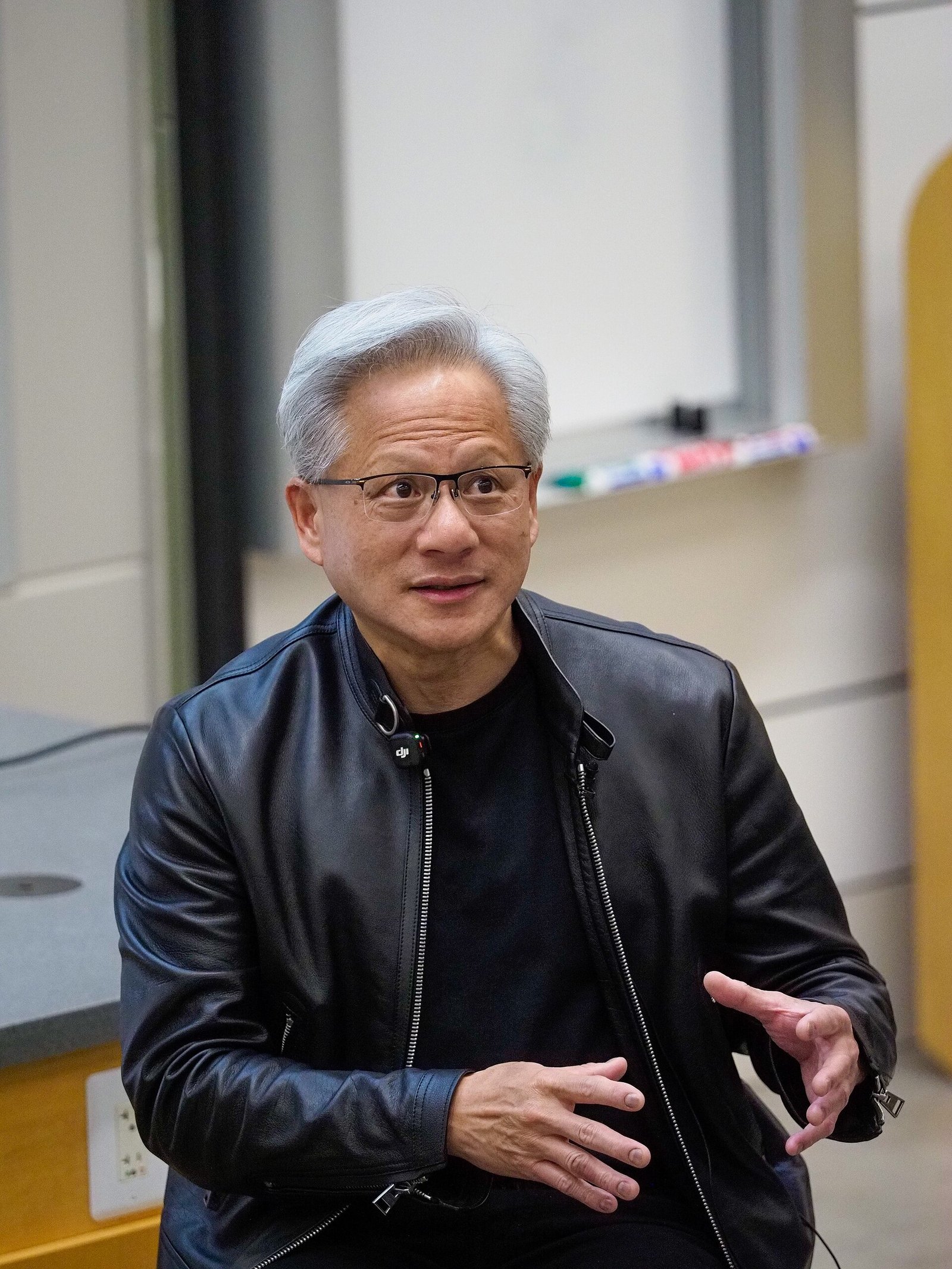
What actually happened to Huang?
November 4. House committee leaders wrote to Huang seeking a briefing after public reporting raised questions about his relationship with Chinese businesswoman Alice Huang. The national-security issue was whether a foreign intelligence effort had targeted someone with influence over US chip export policy. A congressional request establishes what lawmakers wanted to investigate. The letter itself cannot establish what information, if any, changed hands. Read the lawmakers’ letter.
November 8. Huang acknowledged an affair. NVIDIA’s board commissioned an investigation, overseen by independent directors with outside counsel. The board said that, on the information then available, it had no reason to believe that national security or NVIDIA secrets had been compromised. China’s foreign ministry rejected the intelligence allegations. Huang’s acknowledgment, Beijing’s denial and the directors’ preliminary assessment answer three different questions. None settles what the inquiry will find. NVIDIA board statement · Associated Press on the evidence and disputed claims.
November 11–12. The SEC filing supplies a detail easy to miss in the headlines. The board accepted Huang’s resignation as president, CEO and director on November 11, effective immediately. NVIDIA announced it publicly on November 12. Finance chief Colette Kress took over as interim CEO while retaining the CFO role. Harvey C. Jones, a director since 1993, became board chair. The company said it would consider internal and external candidates for the permanent job. NVIDIA’s Form 8-K · Public announcement.
What else was reported? The Associated Press described reports of a relationship with an executive who reported to Huang. On November 12, Reuters separately reported, citing two people, a relationship with a second NVIDIA employee. NVIDIA declined to comment on that later report. A workplace relationship involving a chief executive raises questions about who could safely report a concern and who had the authority to act on it. Those questions would still matter even if the security investigation ultimately found that no secrets had been lost. AP’s account · Reuters’ separately sourced report.
Who is suing NVIDIA, and over what?
On November 9, before Huang resigned, retail investor Mark Kistenmacher filed a proposed class action against NVIDIA and Huang in the US District Court for the Northern District of California. The Rosen Law Firm represents him. The complaint covers people who bought NVIDIA shares between October 9, 2025 and November 8, 2026, and argues that the company’s statements “artificially inflated” the stock while the relationship stayed hidden. CBS News on the complaint.
The detail that gives the case its edge is who Alice Huang is reported to be: a former executive at Megaspeed, a Singapore-based buyer of NVIDIA chips. A relationship with someone on the customer side is a different governance question from a private affair. NVIDIA lost roughly $190 billion in market value that Monday. The independent directors then hired the law firm Wachtell, Lipton, Rosen & Katz for what they called a “thorough and independent investigation.” Decrypt on the suit and the board’s response.
No class has been certified, and a court will choose a lead plaintiff from competing investors later. President Trump has said Huang told him he had “absolutely no idea” the woman was a spy, and that the FBI is looking into the matter. Until an investigator or a court says more, the lawsuit mainly shows which question lawyers think is worth money: what did the company know, and when did shareholders hear it?
Trump wanted Tim Cook. Musk said he would hire Huang.
Trump’s public position changed with the circumstances. On November 8 he called Huang “honorable,” praised what he had contributed to the United States and said the two had not discussed the allegations. After the resignation became public, Trump proposed former Apple CEO Tim Cook for the job. For a shareholder trying to work out who is actually in charge, the operative name on the SEC filing is Colette Kress. Cook was the president’s suggestion. The board announced its own search. Reuters on Trump’s November 8 remarks · Reuters on his proposal after the resignation.
Musk first replied “I agree” to a defense of Huang by investor Shaun Maguire. Then, on Wednesday evening, an X account asked him to hire Huang. Musk answered, “That would be an honor.” The timing matters. He wrote it before NVIDIA publicly announced the departure. There was no stated position, compensation package or acceptance. What Musk did put on the record was that his estimation of Huang as a technology executive had survived the first days of reporting. The Guardian on the initial response · Business Insider on the hiring exchange.
Washington has a decision to make that carries more weight for the company than the president’s preferred candidate. House Speaker Mike Johnson said lawmakers were moving toward agreement on limiting chip exports to China. House Foreign Affairs Chair Brian Mast said he expected Huang to testify. A stronger restriction, if enacted, could change which products US companies may sell and where customers can deploy them. The November 12 remarks were a signal of political pressure. They gave investors neither a final rule nor the findings of a hearing. Reuters on Congress and export policy.
What the world saw from three different seats
In Taiwan, equipment orders and factory commitments dominated the conversation. In South Korea, the question reached suppliers of the high-bandwidth memory that feeds data to AI processors. Reuters reported that TSMC shares traded down around 2%, SK Hynix fell 1.6% and Samsung rose 0.8% in the session it covered. Even companies exposed to the same industry moved in different directions. Naver founder Lee Hae-jin recalled Huang personally sketching a plan for collaboration on a whiteboard. A successor can inherit the document. Rebuilding the ease with which a partner picks up the phone takes longer. Reuters’ interviews with Asian partners and investors.
US retail investors saw a buying opportunity. Vanda Analytics estimated that they bought roughly $111 million of NVIDIA shares in the opening half hour. European equities told another story. The comparatively tech-light STOXX 600 reached a record intraday, even as Asian chip shares were under pressure. It is tempting to call any one of these moves the world’s verdict on Huang. A Korean memory supplier deciding whether to expand a plant and a US trader buying a morning sell-off have different money at risk and different clocks. US trading and retail flows · Reuters’ European market report via Euronext.
Inside the US market, money moved toward NVIDIA’s competitors. AMD rose 5.86% and Broadcom 5.54% on Thursday, the two best performers in the S&P 500. Companies that rent out NVIDIA hardware went the other way: CoreWeave fell nearly 12%, Nebius about 17% and IREN 8%. NVIDIA itself closed down 4.34%, erasing roughly $182 billion of market value, and its worth slipped below $4 trillion for the first time since July 2025. Yahoo Finance on AMD and Broadcom · CBC on the market fallout · Al Jazeera on the $4 trillion line.
Read together, those moves say something specific. Traders did not decide AI demand was over. They bet that buyers would use the turmoil to spread orders around, and that the smaller firms living on NVIDIA supply were the most exposed if anything slipped.
Who could replace Jensen Huang as NVIDIA CEO?
The board says it will consider internal and external candidates and has given no timeline. Four names come up most often, and none has been confirmed. CBS News asked Wall Street analysts · Reuters on the internal favorites.
- Ian Buck. The engineer most associated with CUDA, the software layer that keeps developers on NVIDIA chips. Traders on Kalshi gave him about a 35% chance, though volume on these markets is small.
- Colette Kress. The interim CEO and CFO since 2013. Analysts who spoke to CBS called her a solid caretaker but doubted she would get the job permanently.
- Tim Cook. President Trump’s public pick on Truth Social. Polymarket traders leaned his way, but we found no public comment from Cook, and the board answers to shareholders, not the White House.
- Rene Haas. Arm’s CEO spent seven years at NVIDIA running its computing products business, which makes him the most obvious outside insider.
The choice matters less for who gives keynotes and more for who signs supply contracts. An engineer would reassure the developers who write CUDA code. A finance chief would reassure the people who model margins. A famous outsider would reassure the market and nobody inside the building.
Colette Kress inherits $89 billion of quarterly data-center sales
Kress joined NVIDIA as CFO in 2013 after finance roles at Cisco, Microsoft and Texas Instruments. Her appointment puts someone who knows the payment schedules, gross margins and customer commitments in charge for the next earnings call. It also gives the board a practical test. Can suppliers and engineering leaders agree to the next round of commitments with the same speed once the final signature belongs to someone else? Kress’s company biography.

| Fiscal Q2, ended July 26, 2026 | Reported result | What it means for the next CEO |
|---|---|---|
| Revenue | $96.22 billion, up 106% year over year | Growth expectations now start from a much larger base. |
| Data Center revenue | $89.0 billion | About 92.5% of sales came from this segment. |
| GAAP gross margin | 75.0% | About 75 cents of each sales dollar remained after the direct cost of the products. |
| GAAP diluted earnings per share | $2.46 | Adjusted EPS was $2.22. Mixing the measures distorts comparisons. |
| Operating cash flow | $24.08 billion | Cash collection gives investors another way to track the buildout. |
Quarterly financial tables filed with the SEC.
There is a revealing detail deeper in the filing. Five direct customers accounted for 22%, 14%, 13%, 11% and 10% of accounts receivable at the July close. Together that is 70% of outstanding customer balances. Direct purchasers can include distributors and system builders supplying other companies, so the table cannot tell you that five end users account for 70% of sales. It tells you whose payment schedules can move the cash figure. NVIDIA also disclosed that some investment-grade customers could receive terms of 90 days to a year for large data-center builds. When sales surge, the distance between shipping a system and collecting the last dollar is worth following. NVIDIA’s receivables and payment-terms disclosure.
How many analysts downgraded NVIDIA after Huang left?
TipRanks counted ten downgrades in the days around the resignation. The pattern is more useful than the count. Almost nobody cut their view of NVIDIA’s products. They cut how much they were willing to pay for the years after Huang. TipRanks’ tally.
| Firm (analyst) | Rating | Price target |
|---|---|---|
| Goldman Sachs (James Schneider) | Buy, unchanged | $220, unchanged |
| Bernstein (Stacy Rasgon) | Outperform to Market Perform | $400 to $200 |
| Evercore ISI (Mark Lipacis) | Outperform to In Line | $465 to $186 |
| Melius Research (Ben Reitzes) | Cut to Hold | $315 to $185 |
| Truist (William Stein) | Buy to Hold | $174 |
| Oppenheimer (Rick Schafer) | Outperform to Perform | Withdrawn |
| StoneX (Cody Acree) | Buy to Hold | $335 suspended |
| Cantor Fitzgerald | Overweight, unchanged | $350 to $250 |
Figures as reported on November 11 and 12, and some outlets list different numbers for the same firm. Oppenheimer pointed to the risk of losing engineering talent. StoneX pointed to valuation. Cantor kept its rating and still called it “a very sad day.” Benzinga on the target cuts · Benzinga on Cantor · 24/7 Wall St. on Bernstein · Investing.com on StoneX.
Is NVIDIA a buy at $166.19? Even the analysts disagree.
Goldman Sachs kept its Buy rating and $220 target after the resignation. From the November 12 close, that target implied roughly 32% upside. Bernstein’s Stacy Rasgon lowered his rating to Market Perform. He expressed confidence about near-term operations under Kress but had less conviction about the longer-term outlook. Both positions are intelligible. A system that is already designed and ordered can ship while the board searches for a leader. A customer choosing its next generation of infrastructure can still ask for better terms or test a rival. Goldman’s published call · MarketWatch on Bernstein’s downgrade.
Try reading the price backward. Suppose, purely for illustration, an investor thinks NVIDIA can earn $10 per share in a future year. At $166.19 the investor pays 16.6 times those earnings. If the market ultimately pays 15 times, that very same $10 produces a $150 share price. At 20 times, it produces $200. The business could deliver precisely the earnings the buyer expected and still produce a loss. The starting price, the eventual multiple and the time spent waiting all matter.
| Illustrative annual EPS | Value at 15× earnings | Value at 20× earnings |
|---|---|---|
| $8 | $120 | $160 |
| $10 | $150 | $200 |
| $12 | $180 | $240 |
These are scenarios, before dividends and without discounting future values. They show why a seemingly inexpensive earnings multiple can disappoint if customers slow orders, margins narrow or the market becomes less willing to pay for growth. They also show why some buyers stepped in. A company that can sustain high margins and grow into $12 of annual earnings has room to reward a patient owner at several valuations. The disputed assumption is how much of that future is already dependable.
The numbers to put beside the November 17 earnings release
In August, NVIDIA guided to fiscal third-quarter revenue of $108 billion, plus or minus 2%. That gives a range of $105.84 billion to $110.16 billion. It guided to a 74% gross margin, plus or minus half a percentage point, and assumed no Data Center compute revenue from China. If management describes a China-related headwind, listen for whether it affects the reported quarter, access through overseas customers or opportunities further out. Those three explanations have different implications for the valuation. NVIDIA’s original guidance and assumptions.
- Deliveries and margin. Did sales land inside the August range, and what did shipping those systems cost? A shipment slipping into the next quarter is a different problem from a customer reconsidering an entire build.
- Cash and customers. Compare growth in receivables with growth in sales. Ask whether extended terms reflect a handful of unusually large installations or a broader change in what customers need to afford the equipment.
- Authority and oversight. Who now approves major supply commitments? What can independent directors say about the scope and timing of the inquiry? A smooth earnings presentation can answer the operating question while leaving the governance question open.
Pylcrow’s take, November 13. At $166.19, Pylcrow would wait for the November 17 numbers before calling the dip a buy. The technology case is strong, and the board put an experienced operator in charge within a day. What holds us back is the mix of concentrated customer balances, huge expectations, a shareholder lawsuit and a leadership change in the middle of a capital-intensive expansion. Delivery against guidance, cash following sales and partners willing to commit to the next round of capacity would strengthen the case. A bounce in the share price alone would tell us less.
- Documented: Huang resigned as president, CEO and director on November 11. Colette Kress is interim CEO and Harvey C. Jones is board chair (NVIDIA’s 8-K).
- Documented: a proposed shareholder class action was filed on November 9. Nothing in it has been proven.
- Claimed: that Alice Huang worked for Chinese intelligence. Beijing denies it, and the board’s early review found no sign that NVIDIA secrets were compromised.
- Interpreted: that customers will slow orders because the founder is gone. No customer has said so on the record.
- Unresolved: who the permanent CEO will be, what the board’s inquiry finds, and whether Congress tightens chip exports to China.
The clearest answer may eventually come from that supplier in Taiwan. Long after the television panels have moved on, somebody at NVIDIA will ask a partner to buy equipment for chips that customers have yet to order. Watch whether the partner signs, on whose assurance, and on what terms. That is where the company Huang built will find out how much of his authority it kept. NVIDIA’s confirmed November 17 reporting date.
Quick answers
Why did Jensen Huang resign? He resigned on November 11 after acknowledging an affair with Alice Huang, whom US lawmakers asked about as a possible Chinese intelligence target, and after reports of relationships with NVIDIA employees. The board’s investigation is still open.
Who runs NVIDIA now? CFO Colette Kress is interim CEO while keeping the finance job. Harvey C. Jones, a director since 1993, became NVIDIA’s first board chair, and the search for a permanent CEO includes outside candidates.
Read next: why gamers turned on NVIDIA’s DLSS 5 faces.
Sources: NVIDIA 8-K and press releases, SEC filings, Reuters, Associated Press, CBS News, CBC, Al Jazeera, Wall Street Journal, Business Insider, The Guardian, Benzinga, TipRanks, Investing.com, 24/7 Wall St. Prices as of the November 12, 2026 close.