The Bat-Woman: Albert Pénot and the Dark Art of the Femme Fatale
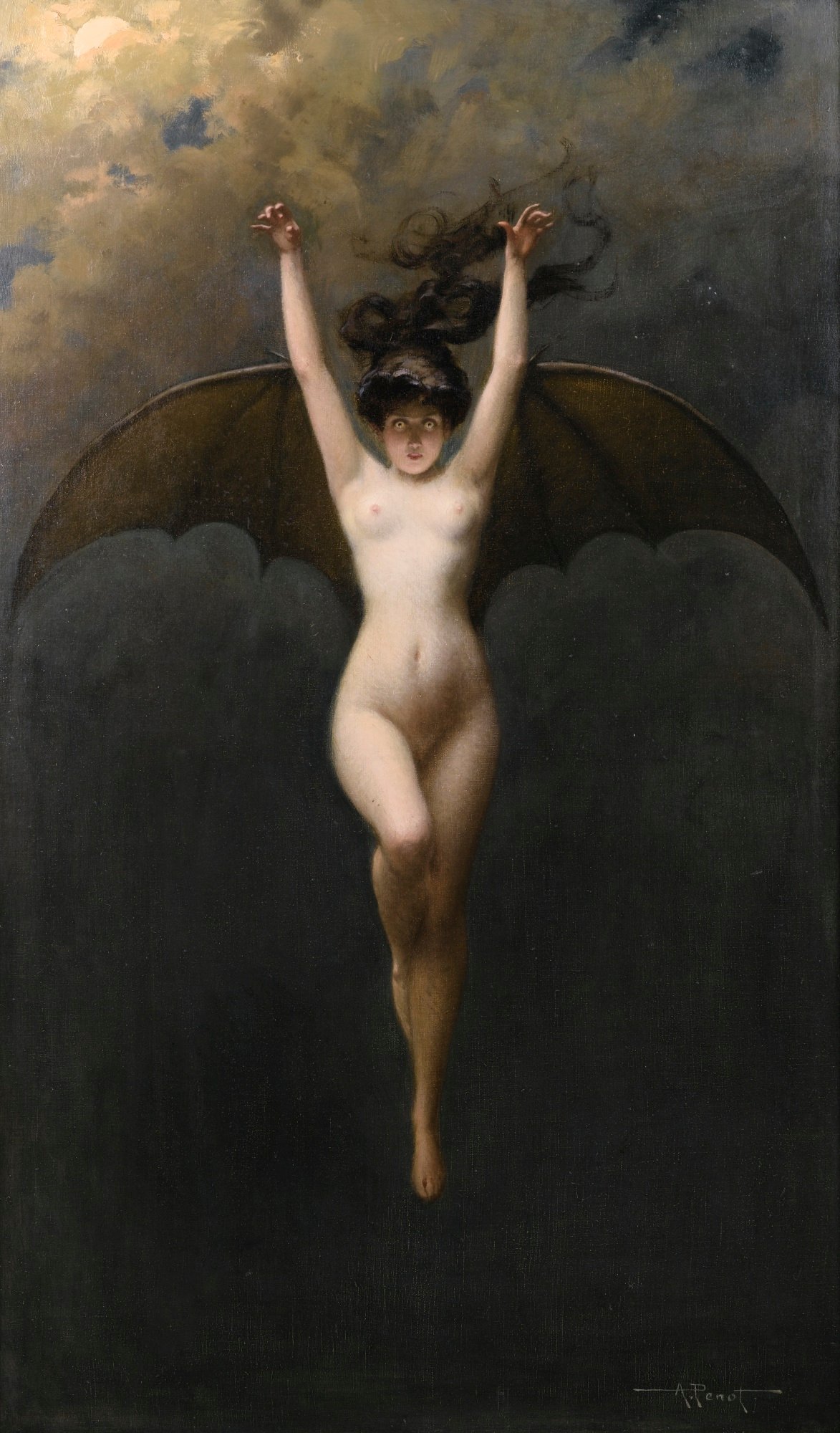
Look at her eyes before you look at her wings.
There is something strange about the woman suspended in Albert Joseph Pénot’s dark sky. Her arms reach above her head, her hair seems caught in a current of air, and two enormous bat wings stretch across the canvas. She looks almost recognizably human, except for the one detail that makes everything else impossible.
Painted around 1890, The Bat-Woman appeared before Dracula became a literary icon and long before Batman entered popular culture. Yet it looks remarkably familiar to a generation raised on supernatural horror, Gothic fantasy and video games.
Who is she? A demon, a vampire, a witch, a woman transformed into something else? The painting does not provide a definite answer. And that might be its greatest strength.
The Bat-Woman: a painting with no obvious story
The composition is almost theatrical. The spread of the wings creates a dark shape behind the illuminated figure. The raised arms echo the upward movement of the hair, while the narrow canvas emphasizes her seemingly weightless descent or ascent. Without a horizon or a nearby object to establish distance, we cannot even tell how close she is.
Her eyes are small in relation to the canvas, but they are unusually important. The encounter feels direct. She is not looking at another character or reacting to a visible threat. She seems to be looking out at us.
That is a striking parallel to Franz von Stuck’s Lucifer, painted in the same period. Stuck conceals the wings and lets the gaze emerge from darkness; Pénot displays the wings openly and lets the gaze complete the encounter. One figure is motionless, the other apparently in flight. Neither tells us what happens next.
There is no confirmed narrative identifying Pénot’s figure as a particular mythological character. That does not mean he invented the idea of a winged supernatural woman from nothing. Demons, witches, sirens and other human-animal hybrids had already populated European art for centuries.
Who was Albert Joseph Pénot?
Albert Joseph Pénot (1862–1930) was a French painter born in Xermaménil who later worked in Paris. His training and style belong to the academic tradition, but his imaginary subjects overlap with Symbolism. The Art Renewal Center catalogs several works, including The Flower Woman, The Little Cicada and Departure for the Witches’ Sabbath. A biographical profile records his participation in the Salon des Artistes Français and his third-class medal in 1908.
Compared with artists such as Munch and Stuck, Pénot has a relatively thin accessible documentary record. We could not establish a reliable portrait of the painter or a firsthand explanation of this painting’s intentions. That is a limitation worth acknowledging rather than filling it with a story about secret beliefs or occult practices.
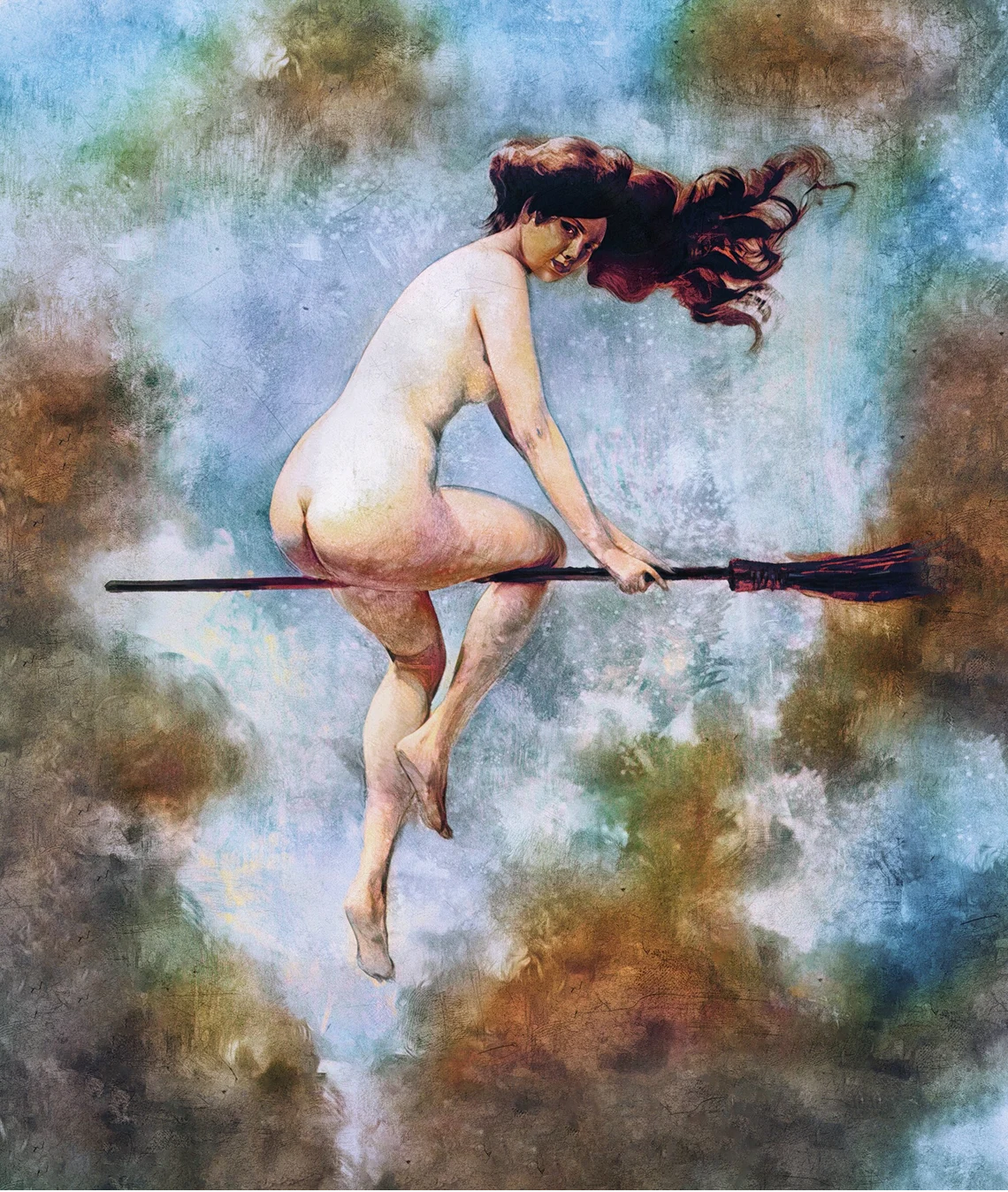
His other surviving pictures are revealing. In Departure for the Witches’ Sabbath, dated 1910, a woman flies through a colorful sky on a broomstick. The supernatural subject is unmistakable, but the mood is lighter and almost playful compared with The Bat-Woman. Both works place the human figure somewhere it cannot physically be.
1890: when the modern world began dreaming of monsters
To understand this image, it helps to place it in the fin de siècle, the cultural atmosphere of the closing decades of the nineteenth century. Industrialization, urban growth and scientific discovery were transforming everyday life. Meanwhile, writers and artists were exploring dreams, religious doubt, emotion and the irrational.
The Metropolitan Museum of Art’s history of Symbolism traces the movement’s emergence from French literature in the 1880s. Rather than treating objective reality as the only worthwhile subject, Symbolists used imaginative scenes to communicate internal experience. Myth and fantasy were ways of making invisible feelings visible.
Pénot painted around the time of Stuck’s Lucifer (1890), Munch’s The Scream (1893) and the publication of Bram Stoker’s Dracula (1897). Vampire literature itself was older: Sheridan Le Fanu’s Carmilla appeared in 1872. These dates show that The Bat-Woman belongs to an existing Gothic imagination, not that it directly influenced later vampire stories or superheroes.
What makes Pénot distinctive is the collision of academic realism and fantasy. A precisely modeled human figure inhabits a physically impossible situation. The believable technique gives the unbelievable subject a convincing presence.
Before Dracula and Batman: a timeline of the bat in popular culture
The most fascinating part of Pénot’s painting is its place in history. Long before Gotham City existed, the bat silhouette already represented something supernatural, nocturnal and difficult to trust. Here is how the image fits into a larger cultural timeline.
| Year | Work or character | Why it matters |
|---|---|---|
| 1872 | Carmilla — Sheridan Le Fanu | A female vampire entered Gothic literature decades before Dracula. |
| c. 1890 | The Bat-Woman — Albert Joseph Pénot | A human figure with literal bat wings appears in French academic fantasy painting. |
| 26 May 1897 | Dracula — Bram Stoker | The novel popularizes the shape-shifting Count, who can assume the form of a bat, approximately seven years after Pénot’s painting. |
| 1922 | Nosferatu — F. W. Murnau | An unauthorized adaptation of Dracula brings Gothic vampire mythology into German silent cinema. |
| 14 February 1931 | Dracula — Tod Browning | Bela Lugosi’s Count helps establish the vampire’s enduring cinematic image. |
| 30 March 1939 | Batman — Detective Comics #27 | Bob Kane and Bill Finger introduce the masked crimefighter, approximately 49 years after Pénot’s painting. The issue is cover-dated May 1939. |
| 1956 | Batwoman — Detective Comics #233 | The original Batwoman, Kathy Kane, debuts approximately 66 years after the painting. |
| 1991 | Batman & Dracula: Red Rain | Doug Moench and Kelley Jones explicitly unite the two traditions in an alternate-universe horror comic. |
| 2006 | Kate Kane — 52 | A modern incarnation of DC’s Batwoman arrives. |
Did the painting inspire Dracula or Batman?
Chronology establishes that the painting predates both, but it does not establish influence. The Bram Stoker Estate’s account of Dracula’s sources documents the author’s research into Transylvanian folklore, travel writing and earlier Gothic fiction. It does not identify Pénot’s painting as an inspiration.
In a 1989 interview with The Christian Science Monitor, Bob Kane recalled three influences on Batman: Leonardo da Vinci’s bat-winged flying-machine designs, Douglas Fairbanks’s Zorro and the 1930 mystery film The Bat Whispers. Bill Finger helped develop the character’s distinctive visual identity and wrote his first story. We found no documented connection to Pénot’s work in those accounts.
What we can trace is a shared visual language. Pénot uses bat wings to make a human figure uncanny. Dracula uses the bat as a sign of supernatural transformation. Batman turns that fear into a weapon against criminals. Batwoman inherits that superhero symbolism. And in Red Rain, the vampire and superhero traditions finally collide in an actual crossover.
It is tempting to call Pénot’s figure the original Batwoman. As a visual comparison, the idea is fascinating; as a claim about the comic character’s origins, it is unsupported. The real story is how a single animal silhouette has been reinvented across painting, literature, cinema and comics for more than a century.
The dangerous woman: a recurring image in Symbolist art
One of the period’s recurring figures was the femme fatale, a woman presented as simultaneously attractive and threatening. The Musée d’Orsay’s exhibition on Dark Romanticism explores the many ways artists used mythological and biblical women to express anxieties about desire, destruction and nature.
These images also reflect the prejudices of their time. As women’s social roles changed, some artists projected their fears of female independence onto supernatural characters. The Allen Memorial Art Museum’s discussion of Munch describes how women who departed from conventional domestic expectations could be portrayed as dangerous within his artistic circle.
That history does not oblige us to accept its assumptions. Looking at Pénot’s figure today, we might see a threat, but we might equally see freedom, transformation or a being comfortable in her own power. Perhaps the most revealing thing about the painting is how different viewers supply different motives for a figure whose intentions are never established.
Three other works from this dark corner of art history
Gustave Moreau — The Apparition (1876)
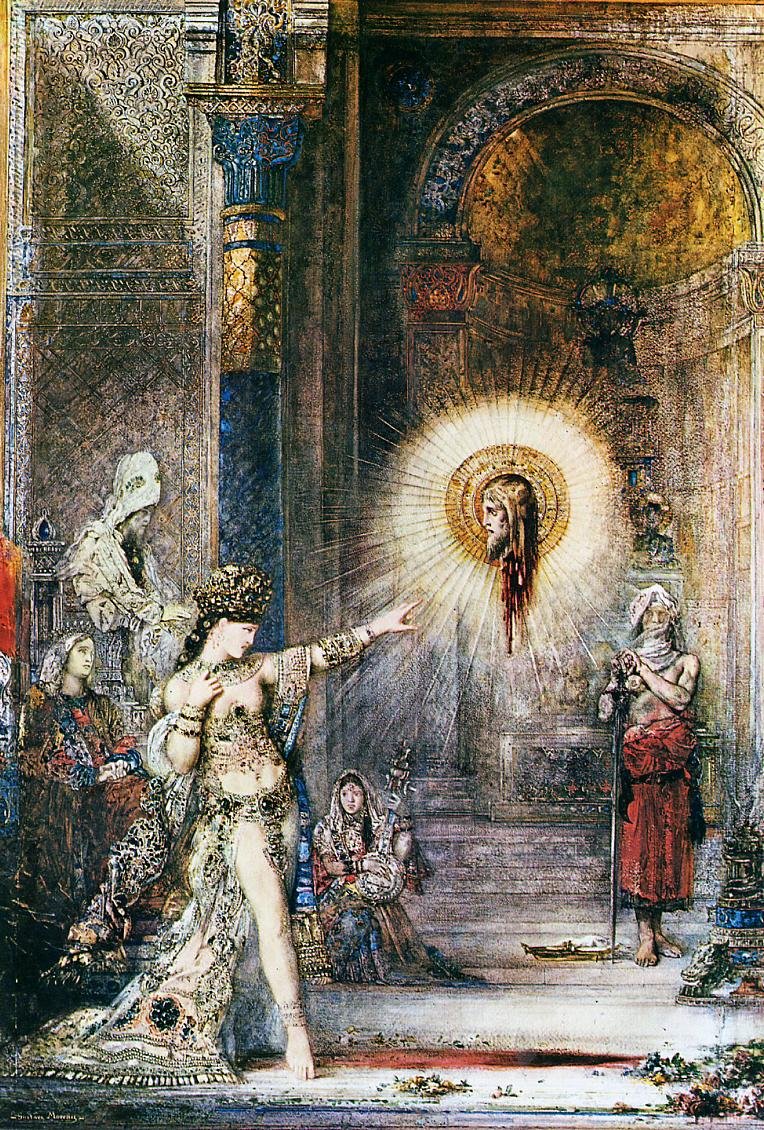
Moreau turns the biblical story of Salome into a supernatural encounter. The severed head of John the Baptist appears before her, glowing within a halo. The elaborate architecture makes the vision feel distant from ordinary reality. It is not merely a scene of violence; it is a confrontation with its consequences.
The Musée Gustave Moreau explains how the artist developed this apparition beyond the biblical episode. Unlike Pénot’s isolated figure, Moreau gives us an explicit narrative. The dread comes from seeing something that should no longer be alive apparently return to confront the living.
Edvard Munch — Vampire (1893)
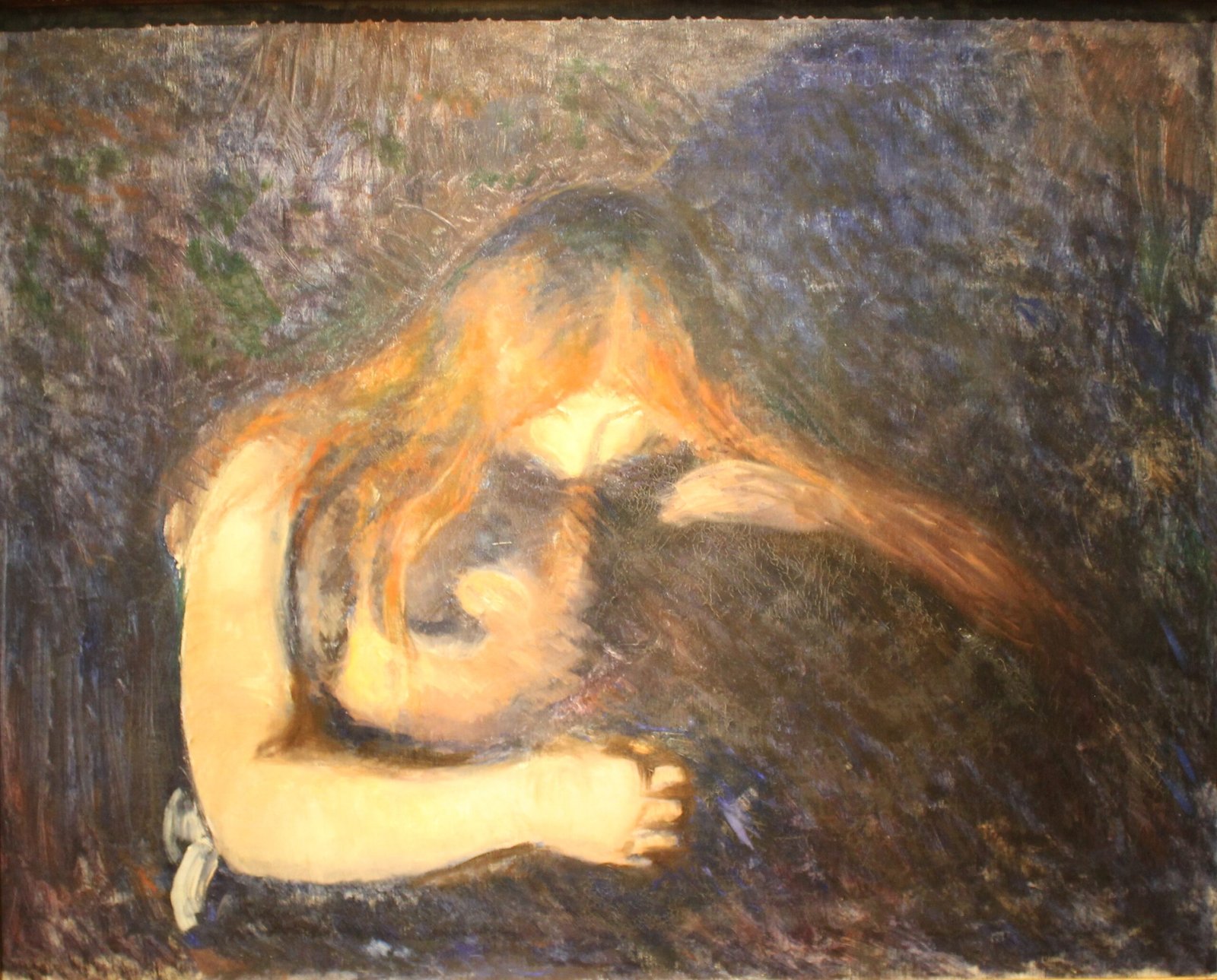
There are no bat wings or visible fangs here. A red-haired woman bends over a man and enfolds him in her hair. Is she comforting him, kissing him or feeding on him?
According to MUNCH museum, the motif was originally named Love and Pain; the vampire title was probably suggested by the writer Stanisław Przybyszewski. The later name transforms a potentially intimate scene into a predatory one. The visual evidence remains the same, but the viewer’s interpretation changes. Few examples illustrate more clearly how easily an image can be demonized by its title.
Franz von Stuck — The Kiss of the Sphinx (1895)
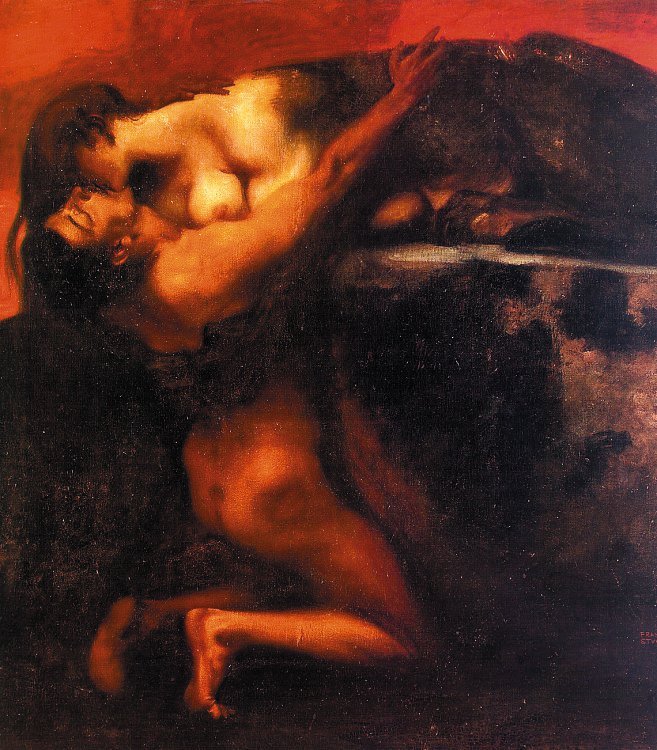
Stuck returns to the human-animal hybrid, but this time the creature is recognizably drawn from mythology. Her embrace appears both intimate and dangerous. The composition compresses the two figures into a space dominated by red and darkness.
The Museum of Fine Arts, Budapest situates the painting within Stuck’s recurring exploration of lethal attraction. Where Pénot lets uncertainty emerge from a solitary figure, Stuck places the potential consequences of that attraction directly before us.
Haunted paintings, or paintings we have learned to fear?
There is another category of dark art: objects that acquire supposedly supernatural reputations after leaving the artist’s studio. The stories can become more famous than the images themselves. Bill Stoneham’s The Hands Resist Him became notorious after a 2000 online auction listing alleged that painted figures moved at night. Mass-produced Crying Boy portraits were associated with fires by British tabloids in the 1980s.
We explored both stories in Lucifer and the Art of Fear. They demonstrate why we should separate a supernatural subject from an alleged supernatural object. The stories are part of cultural history, but their paranormal claims are not established facts.
We found no credible documented curse associated with The Bat-Woman. Its unease is a response that its composition can produce, not evidence that the canvas itself is dangerous. Moreover, not every viewer experiences it as frightening. The same image can be beautiful, liberating or sinister depending on the observer.
There is a psychological parallel in research on the uncanny. A 2016 study in the Journal of Vision discusses how inconsistent human realism can contribute to eerie feelings in computer-generated characters. It did not test paintings or Pénot’s work, so it is not a scientific explanation of this particular image. But it offers a useful comparison: something familiar can feel strange when features violate our expectations of it.
Pénot’s figure creates that contradiction in a particularly simple way. We understand her face and posture, but her wings and impossible setting disrupt what we expect of a human body. The painting leaves us to decide whether we are witnessing a threat or merely something unknown.
The painting that returned to the market
The Sotheby’s London auction catalogue identifies the work as a signed oil painting of approximately 100 by 60 centimeters, dating it to around 1890. It records a French private collection by 1912 and an exhibition at the Paris Salon that year under the title Premier miroir. It also identifies a 1979 publication by Patrick Bade that reproduced it. The painting was therefore not entirely hidden or unknown for a century.
It appeared at Sotheby’s on February 15, 2018, with an estimate of £18,000 to £25,000. The reported sale price of £137,500 is more than five times the upper estimate, according to the artwork’s Commons record and Masterworks’ artist profile. Sotheby’s public lot page requires a login to reveal the result, so the final figure is reported rather than independently confirmed from the auction house. The current owner’s identity is not established by the sources we consulted.
It is an unusual journey for an image that now circulates on screens around the world: an academically painted supernatural figure, a documented Salon exhibition, a century of intermittent public visibility, and eventually a new audience encountering her outside the gallery.
The PYLCROW take: the monster is an unfinished story
Modern horror often works hard to explain what a creature is, where it came from and what rules govern it. Pénot never needs to do that. His painting makes a complete visual statement while leaving the narrative open.
Perhaps that is why it remains so interesting. We can imagine it as the opening frame of a Gothic film, the encounter that begins a horror game, or the last image in a story about transformation. None of those associations needs to be the painter’s original intention.
Look again at her gaze. Is she frightened? Is she threatening us? Or is she just looking at a world that has already decided what she must be?
There is no single answer. And more than a century later, the picture still invites the question.
Down the Rabbit Hole
Continue with Lucifer and the Art of Fear: Why Some Paintings Feel Haunted, where we explore the gaze of Stuck’s fallen angel, Goya’s Black Paintings and the legends surrounding supposedly cursed objects. For a contemporary approach to the uncanny, read CopyPaste! Makes a Dress-Up Game Feel Like Existential Horror. Explore more in Deep Cuts.