What sank the Edmund Fitzgerald? The theories, scored on evidence
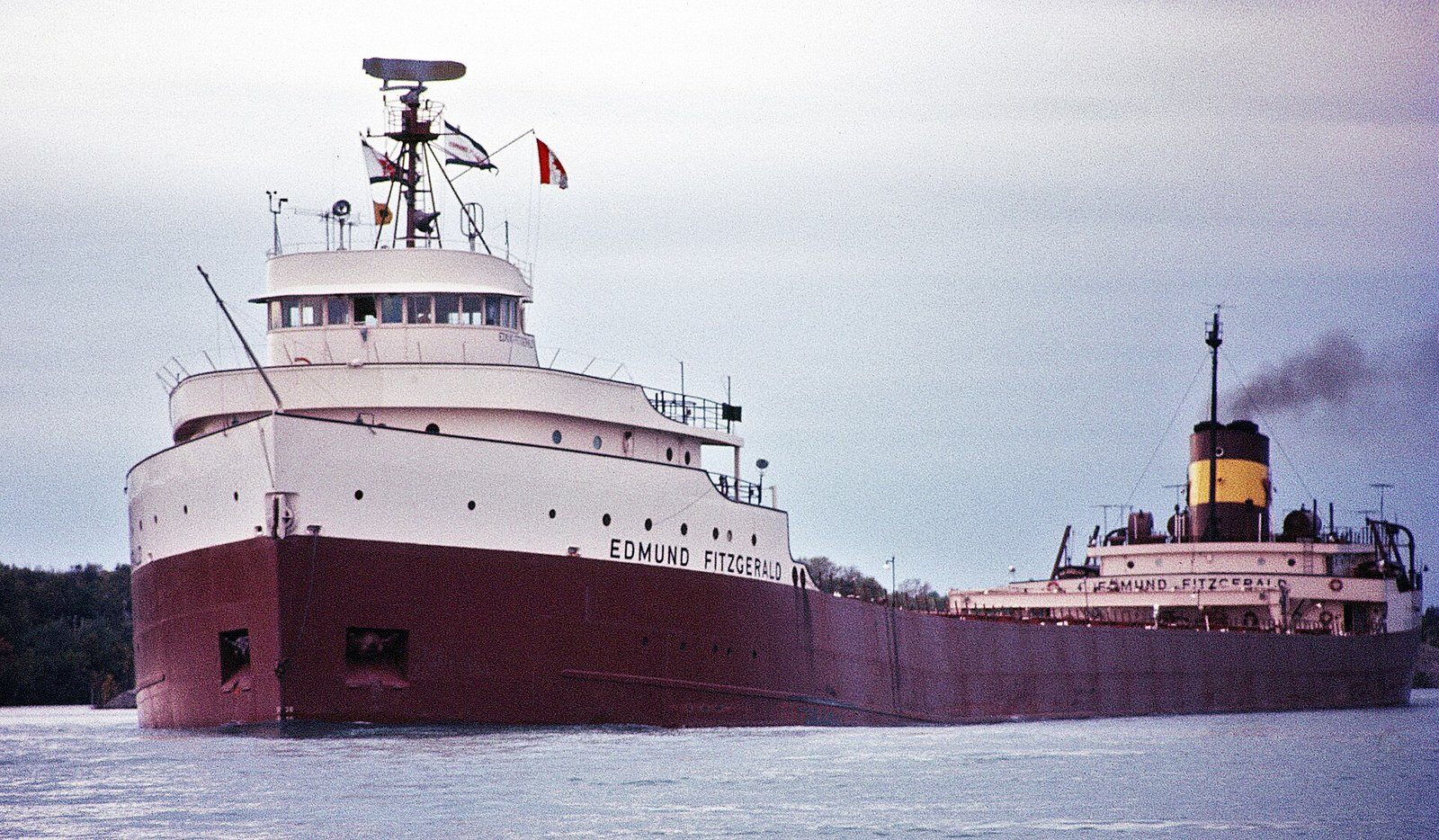
Nobody knows for certain what sank the SS Edmund Fitzgerald. The ore carrier went down in a violent storm on Lake Superior on November 10, 1975, and all 29 men on board died. The official US investigations blamed water flooding the cargo hold, most likely through the hatches. Others argue the ship hit a shoal or was overwhelmed by giant waves. There was no distress call, no survivors and no bodies recovered.
What happened to the Edmund Fitzgerald?
On November 9, 1975, the Fitzgerald left Superior, Wisconsin, carrying about 26,000 tons of taconite iron ore pellets. A November storm turned into one of the worst the lake had seen in years, with hurricane-force gusts and waves reported at 25 feet or more. Another ore carrier, the Arthur M. Anderson, followed several miles behind.
That afternoon, Captain Ernest McSorley radioed that the ship had damage, including two lost vents, and was developing a list. Its radar later failed. At about 7:10 p.m., the Anderson asked how he was doing. McSorley replied: “We are holding our own.” Within minutes, the Fitzgerald disappeared from the Anderson’s radar. It sank about 17 miles from the shelter of Whitefish Bay.
Where is the wreck of the Edmund Fitzgerald?
The wreck lies in about 530 feet of water in Canadian waters of Lake Superior. It sits in two main pieces, with the bow upright and the stern upside down, and debris scattered between them. That shape is the main clue every theory has to explain: the ship broke apart either on the surface or as it hit the bottom.
What are the main theories, and how strong is the evidence?
This is a Case File, Pylcrow’s mystery series, and we score each theory the same way: how well it fits the physical evidence, and how much it depends on guesswork. Scores are our judgement, out of 5.
1. Water got in through the hatches. Evidence score: 4/5
This is the official conclusion. The US Coast Guard’s investigation said the most probable cause was the loss of buoyancy and stability from massive flooding of the cargo hold, through hatches that weren’t fully watertight. The National Transportation Safety Board’s 1978 report blamed the sudden collapse of one or more hatch covers under the waves. It fits the storm, the list and the fast sinking. Its weakness: it relies on the state of hatch clamps no one can fully check from a wreck 530 feet down.
2. The ship hit a shoal. Evidence score: 3/5
The Fitzgerald passed close to the shallow water around Caribou Island. The Lake Carriers’ Association, representing the shipping industry, argued it scraped the bottom there, damaging the hull and letting water in slowly, which would explain the list McSorley reported. Its weakness: dives haven’t produced clear proof of grounding damage on the hull.
3. Rogue waves finished it. Evidence score: 3/5
Crew on the Anderson reported huge waves passing them shortly before the Fitzgerald vanished, a pattern sailors call “the three sisters.” A ship already low in the water could have been pushed under by one big hit. It fits the suddenness. Its weakness: it explains the final blow, not why the ship was already listing.
4. The hull broke on the surface. Evidence score: 2/5
Some researchers argue the long, heavily loaded hull cracked in the waves and split before sinking. The two-piece wreck is the main support. Its weakness: most investigators think the ship broke as it hit the bottom, nose first, which would leave the same shape.
The Pylcrow verdict: the most likely story is a chain, not one cause. Early damage let water in, the ship sat lower and lower, and a final wave or set of waves sent it under before anyone could call for help. Each theory explains part of the night. None explains all of it.
Why do people still care about the Edmund Fitzgerald?
Mostly because of a song. Gordon Lightfoot’s “The Wreck of the Edmund Fitzgerald” came out in 1976 and reached No. 2 on the Billboard Hot 100. It turned a shipping disaster into a ballad people still know by heart. Lightfoot later changed one line in live shows, after newer research suggested the crew hadn’t made a mistake with the hatches. That’s a songwriter correcting the record for 29 families.
The ship’s bell was raised from the wreck in 1995. It hangs at the Great Lakes Shipwreck Museum at Whitefish Point, Michigan. Every November 10 it rings 29 times, once for each man, and once more for all sailors lost on the Great Lakes.
Pylcrow’s take
I’ve heard about it through documentaries and stories about unexplained disasters. I lean toward a combination of extreme weather and structural failure rather than one dramatic event. What stays with me is the fear of how quickly something enormous and supposedly safe can disappear without a trace.
Frequently asked questions about the Edmund Fitzgerald
When did the Edmund Fitzgerald sink?
On the evening of November 10, 1975, on Lake Superior.
How many people died on the Edmund Fitzgerald?
All 29 crew members. None of their bodies were recovered.
How big was the Edmund Fitzgerald?
729 feet long. When it was launched in 1958, it was the largest ship on the Great Lakes.
Can you dive to the Edmund Fitzgerald?
No. The wreck is a protected gravesite under Canadian law, and diving it is banned.
Did the Edmund Fitzgerald send a distress call?
No. Its last message, “We are holding our own,” came minutes before it vanished.
What should you read next?
For another ship that left more questions than answers, read the Mary Celeste mystery and our Mary Celeste theories scorecard. For a case where the man simply vanished, try D.B. Cooper.
Sources: NTSB marine accident report (1978), US Coast Guard Marine Board of Investigation records, BGSU, Great Lakes Shipwreck Museum, Britannica.